
In channel-driven industries like FMCG, consumer goods, automotive aftermarket, building materials, and electronics, growth does not happen at the consumer level first. It happens at the channel level.
- Retailers decide which product gets shelf space.
- Distributors decide which brand gets push priority.
- Influencers and mechanics decide what gets recommended.
Yet most brands still design loyalty programs as short-term schemes rather than structured engagement systems. They focus on quarterly targets, slab-based incentives, and end-of-cycle rewards — without considering how channel partners actually experience loyalty over time.
The truth is simple but often ignored: channel partners move through stages. Their motivations evolve. Their expectations shift. And their engagement patterns change.
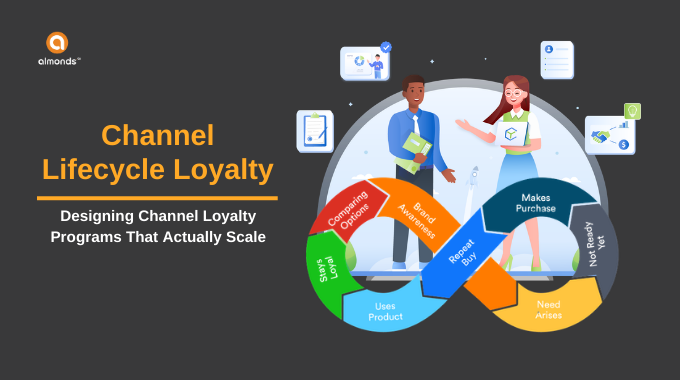
A well-designed channel loyalty program should not remain static. It should align with the lifecycle of the partner. This guide explains how to design lifecycle-based B2B loyalty programs that strengthen retailer engagement, distributor alignment, and influencer participation across every stage of the relationship.
Understanding Channel Lifecycle Engagement
Channel lifecycle engagement refers to the structured journey a partner takes from first association with a brand to long-term advocacy. Unlike customer lifecycle marketing, which is consumer-facing, channel lifecycle design focuses on business partners who operate in highly dynamic, cash-sensitive, and competitive ecosystems.
A retailer’s journey with a brand is not linear. It begins with trial, moves toward experimentation, stabilizes into routine ordering, and eventually becomes either loyalty or silent disengagement.
Most brands treat loyalty as a reward engine layered on top of this journey. High-performing brands treat loyalty as the infrastructure that shapes the journey itself. That distinction changes everything.
Stage 1: Onboarding — Where Loyalty Habits Are Formed
The first interaction a retailer or distributor has with a loyalty program determines long-term participation.
When a new partner joins, they are evaluating reliability more than reward value. They are assessing whether participation will create clarity or confusion. In India’s general trade environment, where retailers handle hundreds of SKUs and operate on tight cash cycles, cognitive simplicity matters more than incentive size. A strong onboarding-stage retailer loyalty program does three things exceptionally well.
- It explains earning logic clearly and concisely. If partners need to decode multiple slabs or SKU multipliers on day one, participation drops before it begins.
- It ensures that the first reward is achievable quickly. Early gratification builds trust. Trust builds routine.
- It integrates loyalty into the ordering workflow rather than positioning it as a separate activity.
When onboarding is frictionless, loyalty becomes part of operational behavior. When it feels optional, engagement remains fragile.
Stage 2: Activation — Turning Registration Into Participation
Enrollment numbers can be misleading. Many channel loyalty programs report thousands of sign-ups but struggle with consistent participation. Activation depends on removing friction at the point of action. Invoice uploads must be simple. Validation must be fast. Reward visibility must be immediate.
At this stage, predictability matters more than reward scale. Retailers prefer knowing exactly how many points they will earn from a transaction rather than speculating about variable multipliers.
Activation also depends on communication clarity. Ambiguity kills participation quietly. When rules feel unstable or overly complex, partners delay action. Delay eventually becomes disengagement. This is why many brands mistakenly believe loyalty “doesn’t work.” In reality, activation design was never optimized.
Stage 3: Growth — Converting Behavior Into Consistency
Once activation stabilizes, loyalty must evolve. This is where many programs plateau. Growth-stage loyalty is not about increasing reward budgets. It is about reinforcing repeat behavior.
Consistency is commercially more valuable than volume spikes. A retailer who reorders predictably every week contributes more long-term value than one who responds only to large quarterly schemes.
This stage benefits from structured progression mechanisms such as tier-based recognition or streak rewards. However, complexity should remain controlled. Growth design must feel achievable, not intimidating.
An always-on channel loyalty program performs better than episodic campaigns because it integrates into habitual decision-making. When partners see cumulative progress, switching brands feels like forfeiting momentum. Growth-stage loyalty strengthens stability across the network.
Stage 4: Engagement Beyond Transactions
Channel loyalty often fails because it remains purely transactional. Money motivates, but recognition sustains. At maturity stages, retailers and distributors begin valuing acknowledgment and visibility. Recognition-based loyalty mechanisms deepen emotional alignment without necessarily increasing financial cost.
This can include performance acknowledgment, training-linked rewards, certification pathways, and milestone recognition. When loyalty recognizes expertise and tenure, it elevates the partner relationship beyond commercial exchange.
Influencers and mechanics, especially in automotive or hardware categories, respond strongly to identity-based incentives. Recognition signals status within the ecosystem. Engagement beyond sales reduces vulnerability during competitive pressure. Partners who feel respected are less likely to shift allegiance for marginal margin differences.
Stage 5: Retention and Advocacy
Retention in channel ecosystems is rarely dramatic. Retailers seldom terminate relationships loudly. Instead, they gradually reduce priority. Silent churn is one of the most underestimated risks in channel loyalty.
Retention-stage loyalty focuses on predictability and fairness. Timely rewards, transparent tracking, and stable rules reinforce trust. Sudden rule changes, delayed payouts, or mid-cycle slab resets damage long-term credibility more than low reward value ever could.
At this stage, loyalty design must reinforce stability. Tenure-based recognition or differentiated benefits for consistent performers strengthen long-term association. Advocacy emerges organically when partners feel secure.
Why Many Channel Loyalty Programs Break Down
Across industries, recurring structural mistakes appear. Programs are often designed internally around finance compliance rather than channel behavior. Reward settlement cycles align with accounting schedules rather than retailer cash realities.
Manual validation processes introduce delays and rejection errors. Even minor processing inconsistencies erode trust disproportionately. Most importantly, brands frequently apply the same loyalty design across retailers, distributors, and influencers. This “one size fits all” approach ignores motivational differences.
Retailers prioritize liquidity and predictability. Distributors prioritize volume alignment and inventory movement. Influencers prioritize recognition and status. When loyalty fails to differentiate, engagement weakens.
The Role of Technology in Channel Lifecycle Loyalty
Technology should simplify, not complicate. Modern B2B loyalty programs benefit from real-time dashboards, automated validation, ERP integrations, and compliance-ready frameworks. However, feature overload without usability reduces adoption.
Mobile-first design is non-negotiable in India’s retail ecosystem. Participation must feel natural within daily routines. Automation strengthens fairness. Automated validation reduces disputes. Compliance integration prevents retroactive complications. Technology must function as invisible infrastructure.
Measuring Lifecycle Success
Traditional loyalty metrics focus on enrollment and redemption rates. Lifecycle-aligned programs measure progression. Activation rate post-enrollment provides insight into onboarding quality. Repeat participation frequency signals stability. Drop-off timing indicates structural weaknesses.
Tracking engagement outside of transactions reveals emotional connection. Lifecycle measurement shifts loyalty evaluation from campaign ROI to ecosystem health.
Designing Loyalty as Infrastructure
The most successful brands treat channel loyalty as infrastructure rather than a marketing tactic. Infrastructure shapes behavior continuously. It does not depend on periodic excitement.
Infrastructure operates quietly but reliably. It builds habits rather than spikes. When loyalty integrates with daily channel activity — from invoice submission to reorder reminders — it becomes indispensable. When loyalty exists only as a quarterly announcement, it remains optional.
The Future of Channel Loyalty in India
The next phase of channel loyalty programs in India will prioritize:
- Predictable reward models over high jackpots.
- Mobile-first participation over manual processes.
- Compliance-integrated design over post-facto adjustments.
- Behavior-led gamification over superficial contests.
- Recognition-based engagement over transactional bribery.
As distribution networks become more competitive and fragmented, lifecycle-aligned loyalty will become a competitive necessity. Brands that master lifecycle design will stabilize revenue and reduce channel volatility. Brands that rely on budget escalation will face diminishing returns.
Final Reflection
Channel loyalty does not fail at redemption. It fails at design. When programs ignore lifecycle progression, they create temporary engagement. When programs align with lifecycle stages, they build sustainable ecosystems.
Retailers, distributors, and influencers do not respond to louder incentives. They respond to clarity, predictability, and respect. Lifecycle-aligned channel loyalty programs are not about spending more. They are about structuring better. And structure is what turns incentives into long-term competitive advantage.
FAQs
1. What is a channel loyalty program?
A channel loyalty program is a structured incentive system designed to reward and engage business partners such as retailers, distributors, dealers, and influencers. Unlike consumer loyalty programs, it focuses on improving channel partner engagement, repeat ordering behavior, and long-term alignment. These programs typically reward sales performance, participation, training, and consistency across the distribution ecosystem.
2. How is a B2B loyalty program different from a customer loyalty program?
A B2B loyalty program targets business partners, while customer loyalty programs target end consumers. B2B programs focus on driving secondary sales, shelf visibility, distributor push, and influencer recommendations. They are usually volume-driven, compliance-sensitive, and designed to align with cash flow realities of trade partners, unlike consumer programs that prioritize brand affinity and purchase frequency.
3. Why do most channel loyalty programs fail?
Most channel loyalty programs fail because they are designed as short-term schemes rather than lifecycle engagement systems. Common issues include complex earning rules, delayed rewards, manual validation processes, and treating all channel partners the same. When loyalty lacks simplicity, predictability, and lifecycle alignment, participation drops silently over time.
4. What are the stages of channel lifecycle loyalty?
Channel lifecycle loyalty typically includes five stages:
- Onboarding
- Activation
- Growth & consistency
- Engagement beyond transactions
- Retention & advocacy
Each stage requires different incentive design. Early stages focus on simplicity and quick wins, while later stages emphasize recognition, predictability, and long-term stability.
5. What motivates retailers in a loyalty program?
Retailers are primarily motivated by predictable rewards, simple earning structures, and fast settlements. In India’s general trade ecosystem, liquidity and clarity matter more than high-value prizes. Retailer loyalty programs that offer instant or near-instant rewards, clear tracking, and transparent rules consistently outperform complex slab-based schemes.
6. How can brands increase channel partner engagement?
Brands can improve channel partner engagement by:
• Simplifying participation
• Automating invoice validation
• Offering real-time reward visibility
• Aligning rewards with partner business needs
• Introducing tier progression and recognition
Engagement improves when loyalty feels reliable and integrated into daily operations rather than seasonal campaigns.
7. Should distributor loyalty programs be different from retailer loyalty programs?
Yes. Distributor loyalty programs should differ from retailer programs because motivations vary. Distributors prioritize volume movement, inventory efficiency, and alignment with primary sales targets. Retailers focus on margin predictability and reorder stability. A uniform loyalty structure reduces effectiveness across both segments.
8. What is an always-on channel loyalty program?
An always-on channel loyalty program operates continuously rather than through periodic schemes. It provides consistent earning opportunities, real-time tracking, and stable rules. Always-on programs integrate into daily business activity, making loyalty habitual rather than reactive to short-term incentives.
9. How does automation improve B2B loyalty programs?
Automation improves B2B loyalty programs by reducing manual errors, speeding up claim validation, and increasing transparency. Automated systems also help with compliance management, invoice verification, and real-time dashboards. This builds trust and reduces disputes, which are common causes of loyalty disengagement.
10. How do you measure the success of a channel loyalty program?
Success metrics for channel loyalty programs include:
• Activation rate post-enrollment
• Repeat participation frequency
• Secondary sales growth
• Partner retention rate
• Tier progression rate
• Reduction in channel churn
Long-term participation and behavioral consistency matter more than enrollment numbers.
11. What role does compliance play in channel loyalty programs in India?
Compliance is critical in India due to regulations such as Section 194R (TDS on business incentives). Loyalty programs must integrate tax deduction, reporting, and transparency mechanisms. Compliance-ready systems prevent financial disputes and protect both brands and channel partners from regulatory risk.
12. Can small and mid-sized brands run effective channel loyalty programs?
Yes. With SaaS-based loyalty platforms, even SMBs can run scalable retailer loyalty programs without heavy upfront investment. Modern systems allow automated onboarding, real-time tracking, and digital rewards, enabling smaller brands to compete with larger players on engagement and consistency.