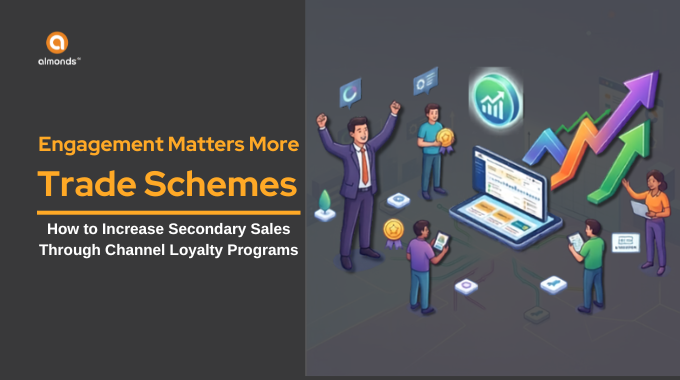

Why Engagement Matters More Than Bigger Trade Schemes
Every manufacturer celebrates a strong primary sales month.
Distributors have placed healthy orders. Dispatch targets have been achieved. Warehouses are moving inventory, and the sales dashboard looks encouraging. Then, six to eight weeks later, the story begins to change.
Distributor orders slow down. Retailers reduce replenishment. Some territories continue to perform well, while others unexpectedly lose momentum. Trade teams launch another scheme to revive demand, but the improvement lasts only until the scheme ends.
If this cycle sounds familiar, you’re not alone. Across industries such as FMCG, electricals, building materials, consumer durables, paints, agriculture, and automotive aftermarket, this has become one of the biggest challenges in channel sales. The issue is rarely a lack of products or promotional budgets. More often, brands lose visibility and influence after products enter the distribution network.
Secondary sales are not driven by inventory. They are driven by people. Dealers, retailers, contractors, influencers, and distributors make thousands of decisions every day about which products to recommend, stock, and reorder. Those decisions shape market movement far more than dispatch numbers.
This is why many manufacturers are rethinking how they engage their channel partners. Instead of relying solely on periodic trade schemes, they are building channel loyalty programs that create consistent participation throughout the year.
The Real Reason Secondary Sales Slow Down
When secondary sales decline, the first reaction is often to increase incentives.
A larger trade discount is announced. An additional slab is introduced. Retailers are offered cashback for a limited period. Dealers receive a new quarterly scheme. These initiatives can create a short-term lift. However, they rarely solve the underlying problem.
In many cases, distributors simply purchase more inventory to qualify for the scheme. Products move into warehouses, but not necessarily into the market. Once the scheme ends, ordering patterns return to normal, leaving brands with little improvement in actual consumer demand.
This is one of the biggest differences between primary sales and secondary sales.
Primary sales measure how much inventory leaves the company. Secondary sales reflect how effectively that inventory moves through the market. A brand can report excellent dispatch figures while still losing shelf space, retailer attention, and market share.
The companies that consistently grow secondary sales understand this distinction. They focus less on pushing inventory and more on influencing channel behaviour.
Secondary Sales Are Built on Thousands of Small Decisions
Retailers rarely choose products based on incentive value alone. Every day they decide:
- Which brand gets better shelf visibility.
- Which product they recommend to a customer.
- Which SKU they reorder first.
- Which new product deserves attention.
- Which company responds faster when support is needed.
Each decision may appear small, but together they determine whether products continue moving through the market.
Many loyalty programs fail because they assume every partner is motivated only by rewards. In reality, long-term engagement is influenced by recognition, communication, convenience, product knowledge, trust, and the feeling that the brand values the relationship beyond occasional promotions.
This explains why two brands offering similar trade benefits often achieve very different secondary sales results.
Why Bigger Trade Schemes Are Delivering Smaller Returns
Over the past decade, trade spending has increased across almost every channel-driven industry. Yet many sales leaders would agree that increasing budgets has not produced proportional growth.
The reason is simple. Trade schemes are becoming easier to copy. If one company offers a quarterly incentive, competitors often launch a similar campaign within weeks. The result is an environment where brands compete on incentive value rather than partner relationships.
Eventually, channel partners begin expecting larger rewards for the same level of business. This creates a cycle where brands spend more each year without fundamentally improving engagement.
A channel loyalty program breaks this cycle because it shifts the conversation from “What will I earn this month?” to “Why should I continue doing business with this brand?” That change is subtle but significant.
What High-Performing Channel Loyalty Programs Do Differently
After looking at successful channel engagement initiatives across manufacturing industries, a consistent pattern emerges.
The strongest programs do not simply reward purchases. They reward participation. They recognise retailers who consistently promote new products. They encourage learning through product training. They reward referrals, feedback, digital interactions, and campaign participation alongside sales performance. This approach keeps partners connected even during periods when purchasing activity slows.
Another characteristic of successful programs is simplicity. Channel partners should never need a manual to understand how they earn rewards or track progress. Complicated rules reduce participation faster than low-value incentives.
Successful programs also communicate regularly. Many brands contact retailers only when launching a new scheme. High-performing programs maintain continuous conversations through updates, learning modules, recognition campaigns, surveys, seasonal activities, and personalised messages.
The objective is not constant selling. The objective is remaining relevant.
The Hidden Cost of Low Retailer Engagement
Most businesses measure the cost of declining secondary sales. Far fewer measure the cost of disengaged retailers. When retailers stop interacting with a brand, the effects extend far beyond immediate sales numbers. New product launches receive less attention. Promotional campaigns generate lower participation. Product recommendations decline. Shelf visibility weakens. Competitors gain opportunities to build stronger relationships.
These losses rarely appear in a monthly sales report, but over time they influence market share, customer preference, and long-term growth. Engagement should therefore be viewed as a business asset rather than a marketing activity.
Why Data Is Becoming the Biggest Competitive Advantage
Many loyalty programs generate large volumes of data but very little insight. Brands know how many partners registered for the program. They know how many points were redeemed. They know how many campaigns were completed.
- What they often don’t know is why participation changes.
- Which retailers are becoming inactive?
- Which distributors consistently outperform similar markets?
- Which campaigns influence repeat purchases?
- Which territories require intervention before sales decline?
Answering these questions allows companies to act before secondary sales begin falling.
This is where modern channel loyalty platforms have evolved. They no longer serve only as rewards engines. They provide behavioural insights that help sales and trade marketing teams make better decisions across their channel network.
A Practical Framework for Increasing Secondary Sales
There is no universal formula, but successful manufacturers typically follow a similar approach.
They begin by defining the behaviours they want to encourage rather than the rewards they want to distribute. They segment partners based on business potential instead of treating every retailer the same. They make participation simple, communicate consistently, and measure engagement alongside revenue.
Most importantly, they review program performance regularly. Channel behaviour changes with seasons, competition, product launches, and regional market conditions. Loyalty programs should evolve at the same pace.
Companies that continuously refine their engagement strategy often achieve more sustainable improvements than those relying solely on periodic trade promotions.
Final Thoughts
Increasing secondary sales has never been about offering the biggest trade scheme. It has always been about influencing the people who move products through the market every day.
Manufacturers that continue focusing only on inventory movement may achieve temporary gains, but sustainable growth comes from building stronger relationships across the entire channel ecosystem.
A well-designed channel loyalty program helps brands stay connected with dealers, distributors, retailers, and influencers long after promotional campaigns end. It creates visibility into channel behaviour, encourages meaningful participation, and supports better decisions through data rather than assumptions.
As competition intensifies across Indian markets, the companies that consistently improve secondary sales are unlikely to be those spending the most on incentives. They will be the ones investing in engagement, understanding their channel partners, and building loyalty that extends beyond transactions.
Frequently Asked Questions
How can a channel loyalty program increase secondary sales?
A channel loyalty program improves secondary sales by encouraging continuous engagement with dealers, distributors, and retailers. Instead of relying only on short-term trade schemes, it rewards behaviours that contribute to long-term market growth, such as repeat purchases, product promotion, training participation, and new product adoption.
Why are trade schemes alone not enough to improve secondary sales?
Trade schemes often generate temporary spikes in distributor orders but may not influence actual product movement at the retail level. Without sustained retailer engagement and visibility into channel behaviour, secondary sales typically return to previous levels once the scheme ends.
Which industries benefit most from channel loyalty programs?
Industries with extensive dealer and distributor networks, including FMCG, building materials, electricals, paints, automotive aftermarket, agriculture, and consumer durables, often see the greatest value because channel partners play a critical role in influencing purchasing decisions.
What should brands measure in a channel loyalty program?
Beyond sales, brands should track active partner participation, repeat purchase behaviour, campaign engagement, retailer retention, new product adoption, redemption patterns, and regional performance. These metrics provide a clearer picture of whether the program is influencing channel behaviour.