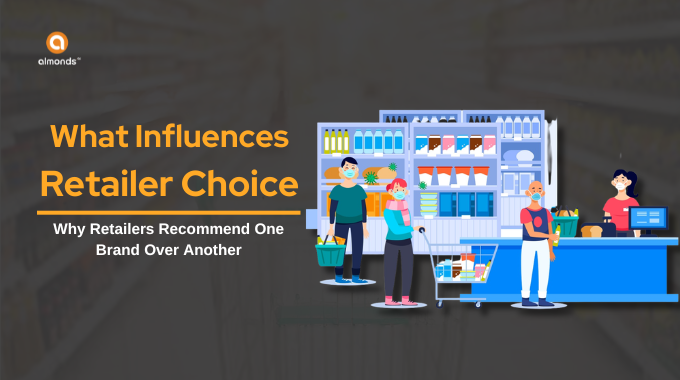

What Really Influences Retailer Choice
A retailer can stock five brands in the same category and still recommend only one or two when a customer asks, “Which one should I buy?”
That recommendation can influence what happens next. The customer may walk out with the product the retailer suggested, while the other four brands remain on the shelf. For manufacturers, this creates an important distinction: getting a retailer to stock a product is not the same as getting a retailer to recommend it.
The distinction matters even more in categories where customers depend on retailer advice. Consumer electronics, electrical products, paints, building materials, agricultural inputs, automotive products and several FMCG categories involve some level of retailer influence at the point of purchase.
A 2026 Ken Research study on consumer durables found that 54% of surveyed shoppers purchased the brand specifically recommended by an in-store advisor, including shoppers who had initially preferred another brand. The study focused on in-store advisors rather than the entire retailer population, so the figure should not be applied to every retail category. But it highlights an important commercial reality: what happens at the point of sale can change brand choice.

The answer is rarely just a bigger incentive.
Stocking a Brand Does Not Mean Preferring It
Manufacturers often use distribution, outlet coverage and billing data to understand their retail presence. These metrics are important, but they do not tell the complete story.
A retailer may stock a product because the distributor supplied it, because the company offers a trade scheme, or because customers occasionally ask for it. None of these reasons guarantees that the retailer will actively recommend the product.
Recommendation requires a different level of confidence.
The retailer needs to believe that the product is worth selling, that the customer will be satisfied, that the brand will support them when something goes wrong, and that the commercial relationship makes sense. When these conditions are stronger for Brand A than Brand B, Brand A has a better chance of being recommended.
This is why retailer loyalty is not simply a rewards problem. It is a preference problem.
What Really Influences Retailer Choice?
There is no single factor that determines retailer preference across every industry. A retailer selling fast-moving consumer goods has different priorities from an electrical dealer or an agricultural input retailer.
However, several factors repeatedly shape the decision.
1. Commercial Value Still Matters
The first factor is the most obvious: economics.
Retailers operate businesses. Margin, sales velocity, payment terms, schemes, credit arrangements and product demand all affect which brands deserve attention. A loyalty program cannot compensate indefinitely for a product that creates poor economics for the retailer.
But commercial value does not necessarily mean the highest incentive wins.
A retailer may prefer a brand with slightly lower margins if that brand sells faster, has fewer returns, receives stronger consumer demand or provides better business support. The real question is therefore not “Who gives the retailer the biggest reward?” but “Which brand creates the better overall business proposition?”
This is particularly important for channel loyalty programs. Rewards should strengthen the commercial relationship rather than attempt to replace it.
2. Product Availability Can Influence Recommendation
A retailer has little reason to recommend a product that is difficult to replenish.
Imagine a customer asking for a product that the retailer knows is currently unavailable. Even if the retailer likes the brand, recommending it creates a poor customer experience and potentially loses the sale.
Availability therefore affects both retailer confidence and customer trust.
KPMG’s 2025 India CX research on FMCG distributors found that expectations around product availability, communication, delivery and operational support play an important role in distributor experience. The research also found that 48% of distributors considered the order-placement-to-fulfilment stage the most impactful interaction with the brand. While this data concerns distributors rather than retailers, the underlying lesson is relevant across channel relationships: a brand’s operational reliability becomes part of the channel experience.
A loyalty strategy cannot fix persistent availability problems. But it can help brands identify where engagement and sales behaviour are changing, allowing channel teams to act earlier.
3. Product Knowledge Gives Retailers Confidence
Recommendation becomes easier when a retailer understands the product.
This becomes particularly important for products that require explanation. A retailer selling electrical equipment, appliances, paints, agricultural inputs or technical products may need to answer questions about features, application, compatibility, performance or usage.
If the retailer does not have that knowledge, recommending the product creates risk. This is where channel engagement can move beyond rewards. A loyalty program can include product learning, short videos, quizzes, certifications and new-product training as part of the partner experience.
The objective is simple: make the retailer more confident about selling the product. This also changes the role of a loyalty program. It becomes a channel education platform rather than just a points account.
4. Brand Support Shapes Retailer Preference
Retailers notice what happens after the sale.
Does the sales representative respond quickly? Are product queries resolved? Are schemes explained clearly? Are claims processed without unnecessary friction? Does the brand provide useful merchandising support? Does someone help when a new product is launched?
These experiences accumulate.
KPMG’s India CX Report 2025 found that 48% of FMCG distributors felt undervalued when brands placed too much emphasis on transactional activities rather than relationship-building. The same research identified expectation and integrity as important pillars of distributor experience.
The finding is useful beyond distributor relationships. Channel partners do not experience a brand only through its rewards. They experience it through the entire process of doing business with the company.
That means retailer loyalty cannot be built by the loyalty team alone. Sales, distribution, customer service, product teams and marketing all contribute to the experience.
5. Recognition Can Matter Beyond Rewards
A retailer who consistently performs well wants to know that the brand notices the contribution.
Recognition does not always need to have a large monetary value. Being acknowledged as a top performer, receiving early access to a new product, completing a certification, participating in a brand event or being featured in a partner community can create a sense of progress and importance.
This matters because channel relationships are not purely transactional.
BI WORLDWIDE India and Kantar’s 2023 FMCG channel-partner research reported that 76% of FMCG channel partners were seeking stronger engagement, while nearly one-third reported low engagement with the brands they worked with. The research points to an important gap: brands may have relationships with large channel networks without necessarily having strong engagement within those networks.
6. Customer Demand Pulls the Retailer Toward a Brand
Retailers are also influenced by the customer standing in front of them.
If consumers repeatedly ask for a particular brand, the retailer has a strong commercial reason to stock and recommend it. This creates a powerful loop between consumer demand and channel behaviour.
India’s retail environment is becoming more connected across offline and digital channels. PwC’s India consumer research found that around five in ten Indian consumers frequently use smartphones in-store for price comparison or to view live product reviews through social media before purchasing. That means the retailer is no longer the only source of information at the point of sale, but the retailer remains part of an increasingly informed purchase journey.
For brands, this creates a new challenge. Retailer engagement must work alongside consumer marketing, product availability and digital information. A retailer cannot be expected to create demand alone.
The Retailer Preference Equation
There is no universal mathematical formula for retailer recommendation. But channel teams can use a simple framework to understand the forces behind retailer preference:
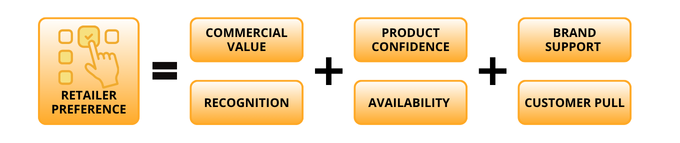
The importance of each factor changes by industry.
For an FMCG retailer, sales velocity and consumer demand may dominate. For an electrical dealer, product knowledge, technical support and product availability may carry more weight. For an agricultural retailer, seasonal demand, product education, farmer confidence and local market support can become particularly important.
The value of this framework is not in assigning a score to every factor. It is in preventing brands from reducing retailer loyalty to margin + points.
Why Bigger Incentives Do Not Always Win Retailers’ Recommendation
This is where many channel strategies go wrong.
A brand sees weak retailer participation and increases the incentive. Participation improves for a period, so the company assumes the problem has been solved. But if the underlying issue is poor product knowledge, weak availability, complicated claims or low trust, a bigger reward only treats the symptom.
There is another problem. Competitors can match financial incentives quickly.
If Brand A increases its reward from ₹500 to ₹700 and Brand B responds with ₹800, the retailer has little reason to develop a stronger relationship with either brand. The program becomes an incentive competition.
The stronger approach is to use incentives as one part of a broader engagement strategy. Financial rewards can motivate action. A strong channel experience can influence preference.
How Channel Loyalty Programs Can Influence Retailer Preference
This is where a well-designed channel loyalty program becomes more than a rewards mechanism.
The program can create regular reasons for the retailer to interact with the brand. Product training can build confidence. Personalized campaigns can communicate relevant offers. Gamified challenges can encourage participation. Recognition can reinforce achievement. Surveys can give retailers a channel to provide feedback.
The important point is that these activities should connect to actual business objectives. A retailer should not receive ten unrelated gamification challenges every month simply because the platform supports gamification. The activity should have a reason.
If a brand is launching a new product, the program might reward product learning and first sales. If the brand wants to increase premium SKU adoption, it can create a campaign around product knowledge and sales performance. If a region has declining engagement, the brand can use targeted communication rather than sending the same campaign to every retailer.
That is where behavior-based channel loyalty becomes more useful than traditional points-based loyalty.
From Rewarding Purchases to Influencing Behaviours
A traditional loyalty program might work like this:

A modern channel engagement program can expand the journey:
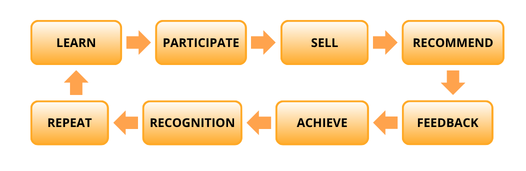
The second model gives the brand more opportunities to influence behaviour.
It also creates more data.
Instead of knowing only how much a retailer purchased, the brand can understand whether the retailer completed training, participated in campaigns, adopted a new product, responded to surveys or became less active over time.
That information can help sales and trade marketing teams make better decisions.
Why Personalization Matters at the Retailer Level
A retailer selling ten categories should not receive the same communication as a retailer focused on only two. Yet many channel programs still send identical campaigns to everyone.
Personalization can change that. A high-performing retailer may need recognition and premium product campaigns. A new retailer may need onboarding and product education. An inactive retailer may need a simple reactivation campaign.
A retailer in a seasonal category may need communication timed around the crop, festival, construction or purchase cycle. The goal is not personalization for its own sake. The goal is to make every interaction more relevant.
Retailer Engagement Is Also a Data Problem
One reason retailer preference is difficult to understand is that much of the relationship historically sits outside the brand’s digital systems.
Sales representatives know which retailers are active. Distributors know who orders regularly. Retailers know which brands they prefer. But these insights often remain fragmented.
A channel loyalty platform can bring more of these interactions into a measurable environment.
The brand can begin connecting participation with business outcomes. It can identify which partners are active, which campaigns generate engagement, which rewards are being redeemed, and where participation is falling.
This becomes especially valuable when the channel network is large.
KPMG’s 2026 outlook for India’s FMCG and consumer sector highlights the importance of stronger data foundations and AI capabilities for sharper demand sensing and better last-mile execution. While that research is broader than loyalty, the direction is relevant: channel decisions are increasingly moving from periodic reporting toward data-led action.
How Should Brands Measure Retailer Preference?
The biggest mistake is to treat enrollment as loyalty.
A retailer joining a program tells you that the proposition was interesting enough to register. It does not tell you whether the retailer prefers your brand.
Brands should therefore look at a broader set of signals.
| Metric | What It Can Tell You |
| Active retailer rate | Whether enrollment becomes participation |
| Repeat purchase frequency | Whether engagement is translating into buying behaviour |
| Product mix | Whether the retailer is adopting priority products |
| New-product adoption | Whether the program can influence launches |
| Campaign participation | Which engagement activities create interest |
| Learning completion | Whether product knowledge is improving |
| Reward redemption | Whether the reward proposition is relevant |
| Retailer retention | Whether the relationship is sustained |
| Sales of engaged vs. non-engaged partners | Whether engagement correlates with business performance |
The last metric is particularly important.
If highly engaged retailers consistently perform better than comparable non-engaged retailers, the brand has stronger evidence that its engagement strategy is contributing to business performance.
Correlation is not proof of causation, so brands should control for factors such as territory potential, retailer size and product availability where possible. But the comparison is still more meaningful than simply reporting how many points were issued.
What This Means for Different Channel-Driven Industries
FMCG
FMCG retailers operate in a high-frequency environment where availability, product movement, margins and consumer demand matter every day. Loyalty programs can support retailer education, new-product launches, merchandising campaigns and repeat engagement rather than focusing only on purchase volume.
Electricals and Consumer Durables
Here, product knowledge can become a major differentiator. Retailers and store advisors may need to explain technical features, compare products and recommend suitable options, making training and recognition important parts of channel engagement.
KPMG’s 2025 research on electronic stores found that 55% of customers considered the purchase stage the most impactful part of their overall experience, while knowledgeable store support and product availability were identified as important elements of the purchase journey.
Paints and Building Materials
Retailer recommendation often sits within a wider network that can include contractors, painters, architects and homeowners. A channel strategy therefore needs to consider not only the dealer’s commercial incentive but also product knowledge, influencer engagement, project support and availability.
Agricultural Products
Agricultural retailers often operate around seasonal demand and product education. A loyalty program can combine retailer rewards with product training, farmer engagement, crop-cycle communication and feedback, helping the brand remain relevant throughout the season.
What Brands Should Ask Before Designing a Retailer Loyalty Program
The first question should not be: “How many points should we offer?” Start with the behaviour you want to change.
If the problem is low new-product adoption, build engagement around product education and first sales. If the problem is weak retailer participation, simplify the experience and improve communication. If the problem is declining repeat purchases, identify the behavioural signals that appear before the decline.
The second question should be: “Why would a retailer recommend us when a competitor offers a similar product?” That answer should shape the program.
If the answer is only “because we give more rewards,” the strategy may be too dependent on incentives. If the answer includes better product knowledge, stronger support, easier business operations, recognition, relevant rewards and reliable availability, the brand has the foundations of a stronger channel relationship.
Retailer Loyalty Starts Before the Loyalty Program
A retailer does not become loyal because an app gives them points.
The app can make engagement easier. It can provide rewards, learning, communication, recognition and data. But the underlying relationship still depends on the value the brand creates for the retailer.
This is why the best channel loyalty programs do not operate as isolated marketing campaigns. They connect sales, trade marketing, product education, communication, rewards and analytics around a common objective.
The ultimate goal is not to make retailers redeem more rewards. It is to give them more reasons to choose, recommend and continue working with the brand. And that distinction matters for secondary sales.
When a retailer stocks your product but recommends another brand, you have distribution without preference. When the retailer understands your product, trusts your support, sees commercial value in the relationship and actively recommends your brand, the channel becomes a stronger engine for market movement.
That is the difference between having a retailer in your network and having a retailer on your side.
Conclusion
Retailer recommendation is one of the least visible but most valuable forms of channel influence.
Brands can measure how much inventory they sell to distributors. They can measure retailer enrollment. They can measure reward redemption. But the harder question is whether a retailer thinks of the brand first when a customer asks what to buy. That preference cannot be purchased permanently through larger incentives.
It is built through commercial value, reliable availability, product confidence, useful support, relevant communication and recognition. Channel loyalty programs can bring these elements together, but their real value comes from using technology and data to strengthen the relationship rather than simply digitizing the old points-and-rewards model.
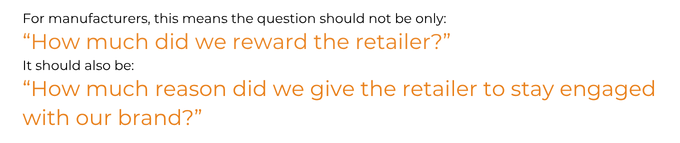
For manufacturers looking to increase secondary sales, the question should therefore move beyond “How do we reward more retailers?”
The more important question is:
“What can we do to give more retailers a reason to recommend our brand?”
That is where retailer engagement becomes channel loyalty—and where channel loyalty can become a stronger driver of secondary sales.
Frequently Asked Questions
Why do retailers recommend one brand over another?
Retailers usually consider several factors when deciding which brand to recommend. Commercial value, product availability, product knowledge, customer demand, brand support, ease of doing business, trust and recognition can all influence retailer preference.
Does offering higher retailer incentives guarantee more recommendations?
No. Higher incentives can encourage purchases or participation, but they do not guarantee recommendation. If a competitor offers better product availability, stronger customer demand, easier business operations or better support, the retailer may still prefer that brand.
How can a loyalty program influence retailer recommendation?
A channel loyalty program can create regular engagement through product learning, personalized communication, rewards, recognition, gamification and feedback. The strongest programs connect these activities to specific business behaviours rather than simply rewarding every purchase.
What is the difference between retailer engagement and retailer loyalty?
Retailer engagement describes how actively a retailer interacts with a brand, while retailer loyalty reflects a more sustained preference for continuing to buy, recommend or work with that brand. High engagement can be an important indicator of a stronger relationship, but enrollment or activity alone does not prove loyalty.
How can brands measure retailer loyalty?
Brands can measure retailer loyalty through a combination of repeat purchase behaviour, retention, product mix, new-product adoption, campaign participation and performance of engaged versus comparable non-engaged retailers. No single metric provides a complete picture.
Why is retailer product knowledge important for brand recommendation?
Retailers are more comfortable recommending products when they understand their features, applications and benefits. Product learning within a channel loyalty program can therefore support both engagement and retailer confidence, especially in technical categories.
Should channel loyalty programs reward retailers for behaviour beyond sales?
Yes, when those behaviours support business objectives. Product learning, new-product adoption, referrals, feedback, merchandising and campaign participation can all be relevant behaviours depending on the brand’s goals.
How does retailer preference affect secondary sales?
Retailer preference can influence which products receive attention, recommendation, shelf visibility and repeat orders. Stronger retailer preference can therefore contribute to product movement beyond the distributor and support healthier secondary sales.