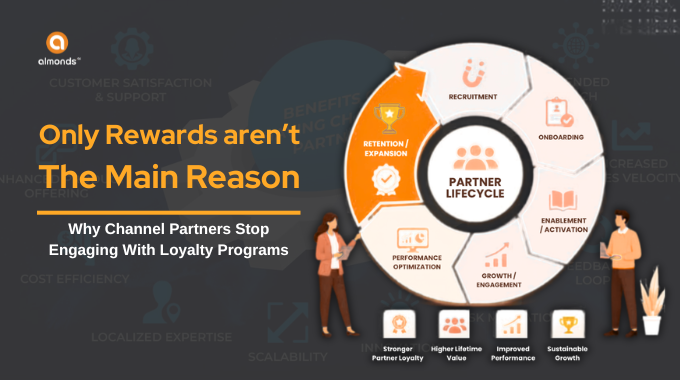

A loyalty program can have attractive rewards, a large partner base and a well-designed app, yet still struggle to keep channel partners active.
The problem is more common than many brands assume. A BI WORLDWIDE–Kantar study of more than 700 channel partners across six industries in India found that 78% of channel partners were not engaged with the brands they worked with. Only 22% were classified as engaged.
This creates an uncomfortable question for manufacturers, distributors and channel leaders: if rewards are one of the strongest tools available to influence channel behaviour, why do partners still disengage?
The answer is not that rewards have stopped working. The bigger issue is that brands often treat rewards as the entire engagement strategy. Partners, however, experience a loyalty program as part of a much larger relationship that includes communication, product knowledge, recognition, service, ease of doing business and the relevance of the brand to their business. That distinction changes how brands should diagnose an underperforming channel loyalty program.
The Channel Engagement Problem Is Bigger Than Rewards
Channel loyalty programs traditionally start with a straightforward proposition: sell more, earn more.
The model is commercially logical. A dealer sells a target quantity, a retailer earns points, a distributor receives an incentive, and the brand gets additional sales. The problem starts when this transaction becomes the only reason for the partner to interact with the brand.
A channel partner may continue participating when the reward is attractive but disengage when the reward becomes less relevant. The brand then sees declining activity and often responds by increasing incentives, creating a cycle in which every engagement problem becomes a reward problem.
Research suggests that the relationship is more complicated.
Report identified eight drivers of channel partner engagement: operational excellence, rewards and incentives, recognition, learning, brand affinity, communication, well-being and events. The research also identified recognition and learning as important drivers across industries and partner profiles.
Rewards are one part of channel engagement. They are not the complete engagement system.
Channel Partner Can Be Loyal and Still Be Disengaged
The research classified 49% of channel partners as Trapped. These partners showed preference for the brand but were not sufficiently satisfied with their relationship with it. The model also identified 23% as Vulnerable, 6% as Unattached and only 22% as Engaged.
This is a useful distinction for channel leaders.
A partner may continue buying from a brand because changing suppliers is difficult, because the brand has strong market demand, or because there are limited alternatives. That does not mean the partner is actively engaged or emotionally committed to the relationship.
Preference without satisfaction creates vulnerability. Satisfaction without active engagement creates another form of risk.
For brands, the real opportunity lies in moving partners from passive participation toward active engagement.
Why Channel Partners Stop Engaging With Loyalty Programs
There is rarely one reason for disengagement. It usually develops when several small problems accumulate over time.
A reward may be attractive, but the partner may struggle to understand how to earn it. The program may offer useful benefits, but communication may be irrelevant. The app may work well, but the partner may receive little recognition outside the reward cycle.
These issues create what we can call engagement friction. The following five forms of friction are particularly important when diagnosing channel loyalty programs.
1. The Reward Is Good, But the Experience Is Difficult
A reward has no practical value if the partner cannot easily understand, earn or redeem it.
This sounds obvious, yet reward redemption remains a significant problem. Almonds Ai’s Channel Loyalty Report 2026 found that 46% of companies reported low channel partner engagement, with complicated reward redemption cited by 42%, poor program communication by 38%, manual incentive processing by 33%, and lack of CRM/ERP integration by 31%.
Consider the retailer’s perspective. If points accumulate but the retailer does not know when they can be redeemed, what they can redeem them for, or when the reward will arrive, the program starts creating work instead of value.
The same applies to claims, invoice uploads, approvals and KYC. Every unnecessary step creates another opportunity for the partner to stop participating.
The lesson is simple: a loyalty program should reduce effort, not add another administrative task to the channel partner’s day.
2. The Program Becomes Repetitive
The first few weeks of a loyalty program can generate strong excitement. Partners register, explore the rewards catalogue, check their points, and participate in the first campaigns.
The challenge begins later. If every campaign follows the same pattern, purchase, upload proof, earn points, redeem reward—the experience quickly becomes predictable. Once the novelty disappears, the program needs another reason to remain relevant.
This is where engagement design matters. A channel program can introduce product learning, achievement milestones, challenges, recognition, surveys, new-product campaigns and partner-exclusive experiences. These activities give partners more reasons to return than simply checking their points balance.
A program needs recurring reasons to engage, not recurring reminders to buy.
3. The Reward Does Not Match the Partner
A dealer, distributor, retailer, mechanic and influencer may all contribute to the same sales ecosystem. Their commercial roles are different, so their motivations are unlikely to be identical.
Research specifically highlights differences across partner types and industries. Its broader framework identifies rewards, recognition, learning, operational excellence, communication and other factors as drivers of channel engagement rather than assuming one universal motivation.
This has an important implication for program design.
A retailer may value recognition and commercial rewards. A distributor may place greater importance on learning and operational support. An influencer may respond more strongly to experiences, recognition or opportunities that strengthen their professional standing.
A single reward catalogue can still serve a broad partner base. But the engagement journey around that catalogue should not necessarily be identical for everyone.
4. The Brand Communicates, But the Partner Does Not Feel Communicated With
Communication is another common source of disengagement. Many brands communicate frequently but still fail to create engagement because they focus on what the brand wants to say rather than what the partner needs to know. The distinction becomes particularly important in India’s diverse channel environment.
A research study involving more than 700 distributors, retailers, and influencers found that 78% preferred receiving brand communication through voice calls, while 50% preferred app-based messaging platforms such as WhatsApp. The research also found that two out of three channel partners use mobile apps for business purposes.
Data point: 78% of surveyed channel partners preferred voice calls, while 50% preferred app-based messaging for brand communication.
This does not mean every loyalty program should rely on WhatsApp or voice calls. It means brands need to understand how different partner groups prefer to receive information. A notification that works for one group may be ignored by another.
Timing matters too. The research found that 3–5 pm was the preferred time for brand communication among the surveyed partners. Communication therefore needs three things: relevance, channel fit and timing.
5. The Brand Rewards Sales but Ignores the Relationship
This is perhaps the most important problem. When a brand only contacts a retailer when it wants another order, the relationship becomes transactional. The partner learns that engagement with the brand has one primary purpose: generate sales.
Recognition can change that dynamic. It does not always require a large financial reward. It can include achievement badges, certificates, partner events, exclusive access, public acknowledgement or direct recognition from the brand team.
The research specifically identifies recognition as one of the eight major drivers of channel engagement and highlights its importance across partner groups.
Insight: Partners do not only want to know what they have earned. They also want to know whether the brand notices their contribution.
Participation Is Not the Same as Engagement
This distinction deserves more attention because it changes how brands measure loyalty programs. A partner who registers for a program is participating. A partner who checks points every month is active. A partner who redeems a reward is engaged with a particular transaction. But none of these actions automatically means the partner prefers the brand.
Channel Loyalty Report 2026 makes this distinction by assessing channel relationships through performance and preference. Preference includes the likelihood of continuing with the brand and confidence in recommending it to industry peers. That is a more meaningful definition of channel loyalty.
How to Identify Channel Engagement Decay
Disengagement rarely happens overnight. In many programs, it appears as a gradual decline in behaviour.
A partner who once participated in every campaign may start ignoring selected campaigns. Reward redemption may slow. Training completion may decline. The partner may still purchase from the brand, but their engagement with the program becomes increasingly dependent on high-value incentives. These are early warning signals.
Look for changes in:
- Campaign participation and repeat activity
- Reward redemption frequency
- Product and SKU mix
- New-product adoption
- Training and learning participation
- Survey and feedback response
- Communication engagement
- Repeat purchases among previously active partners
The important point is to identify behavioural change, not just inactivity. A channel partner who has never used the program is a different problem from a partner whose activity has fallen 60% over six months.
How Brands Can Re-Engage Channel Partners
Re-engagement should start with diagnosis rather than immediately increasing the reward budget.
If the problem is complicated redemption, simplify the journey. If the problem is irrelevant communication, segment the partner base. If partners lack product confidence, add learning and product education. If the relationship feels transactional, introduce recognition and non-transactional engagement.
The solution should address the friction that is actually causing the decline.
Make the Program Easier to Use
The channel partner should be able to understand their target, progress, points and rewards without repeatedly contacting the sales team.
Real-time visibility can remove uncertainty and reduce the effort required to participate. Benepik’s 2025 research similarly highlights the move toward real-time, technology-enabled and more transparent loyalty experiences.
Make Rewards More Relevant
The answer is not always a larger reward.
A better approach is to create reward choices that reflect different partner profiles and program objectives. Travel, utility, merchandise, digital rewards, experiences and business-oriented benefits can serve different motivations.
Channel Loyalty Report 2026 found that 68% of channel partners were extremely satisfied with travel-based rewards, followed by 66% for luxury rewards and 64% for business-infrastructure rewards.
The finding suggests that reward design deserves more thought than simply choosing the highest monetary value.
Add Learning to the Engagement Journey
Product education can give partners a reason to interact with the brand even when they are not making a purchase.
This is especially useful in categories where product knowledge influences recommendation. Training can cover new products, applications, selling techniques, market developments and category knowledge.
This research identifies learning as a key engagement driver and notes that partners value opportunities that help them improve their business and product knowledge.
Learning can turn a loyalty program from a reward account into a channel enablement platform.
Recognise More Than Top Sellers
Many incentive programs concentrate rewards on the highest sales performers.
That can unintentionally make other partners feel that the program is not meant for them. A better approach can recognise progress, improvement, learning, consistency, advocacy or achievement against an individual target.
Recognition becomes more meaningful when partners have a realistic opportunity to earn it.
Communicate According to Partner Behaviour
A dealer who needs product education should not receive the same communication as a high-performing retailer being targeted for a premium SKU campaign.
Partner segmentation can help brands move from mass communication toward more relevant journeys. The 2025 Benepik research also reported stronger outcomes from segmented and role-specific programs, including claims of up to 60% stronger ROI in programs using segmentation; because this is a vendor-reported finding, brands should treat it as directional rather than a universal benchmark.
Don’t Fix the Reward. Fix the Engagement System!
When channel engagement falls, increasing incentives is an understandable response. But it should not be the first response. A channel leader should first ask five questions:
- Is the program relevant to this partner?
- Is participation simple enough?
- Is communication reaching the partner in the right way?
- Does the partner have reasons to engage beyond purchasing?
- Does the brand recognise the partner’s contribution?
These questions help distinguish a reward problem from an engagement problem.
The distinction can have a direct impact on program economics. Increasing incentives can raise short-term participation, but fixing unnecessary friction or improving relevance can potentially improve the experience without simply increasing reward costs.
The Future of Channel Loyalty Is Continuous Engagement
The direction of the market is moving away from isolated incentive campaigns toward more continuous channel engagement. Benepik’s 2025 research describes this shift as a move from traditional, transactional loyalty toward technology-enabled, personalised and partner-centric models. It also highlights real-time engagement, training, recognition and role-specific rewards as elements of future-ready programs.
This does not mean traditional incentives will disappear. They remain an important part of channel economics. The change is that incentives increasingly need to work alongside communication, learning, recognition, data and operational experience. That creates a different role for loyalty technology. Instead of simply calculating points, the platform becomes a layer connecting channel partner behaviour, engagement, rewards and business outcomes.
What Channel Leaders Should Measure
If engagement is broader than rewards, measurement also needs to go beyond redemption. A useful measurement framework should connect three levels.
Program activity
Are partners registering, logging in, participating and redeeming?
Behaviour change
Are they learning, adopting priority products, responding to campaigns, buying more consistently or participating in strategic initiatives?
Business impact
Are engaged partners showing stronger secondary sales, retention, product mix or share of wallet?
This approach prevents brands from celebrating high app activity when the program has little effect on channel behaviour. The ultimate test is not whether partners are collecting points.
It is whether the relationship is becoming more valuable to both sides.
The Real Reason Channel Partners Disengage
Channel partners do not necessarily stop engaging because the reward is too small. They often disengage because the total value of participating has fallen below the effort required to participate.
Sometimes the reward is irrelevant. Sometimes redemption is difficult. Sometimes communication is repetitive. Sometimes the partner does not see progress. Sometimes the brand has stopped recognising them. And sometimes the program simply does not reflect the way that particular partner does business.
The evidence from India points in the same direction. The Channel Loyalty Survey 2026 identifies eight engagement drivers rather than one, while Benepik’s 2025 research highlights operational friction around redemption, communication, manual processing and system integration.
The strongest channel loyalty programs do not simply make rewards more attractive. They make the entire relationship more valuable and easier to engage with. For manufacturers, this changes the question they should ask when a program starts losing momentum.
That question can uncover the real problem—and create a much better path to sustained channel partner engagement.
Final Takeaway
A good reward can start engagement. It cannot sustain a weak partner experience.
The next generation of channel loyalty programs will therefore compete on more than reward value. They will compete on relevance, simplicity, recognition, learning, communication and the ability to understand what each partner needs at different stages of the relationship.
For brands, the strategic shift is straightforward: stop treating disengagement as a reward problem and start treating it as a relationship and experience problem. That is where channel loyalty moves from a periodic incentive program to a continuous engine for partner engagement, preference and business growth.
FAQs
Why do channel partners stop engaging with loyalty programs?
Channel partners can disengage when rewards become less relevant, redemption becomes difficult, communication becomes repetitive, or the program does not provide enough value beyond financial incentives. Research also points to operational excellence, recognition, learning, brand affinity and communication as important drivers of channel engagement.
Are rewards still important in channel loyalty programs?
Yes. Rewards remain an important driver of channel engagement. However, research indicates that rewards work alongside other factors such as recognition, learning, communication and operational experience rather than replacing them.
How can brands increase channel partner engagement?
Brands should first identify the source of disengagement. Simplifying redemption, improving communication, segmenting partner journeys, introducing relevant learning and recognition, and using behavioural data to identify declining engagement can create stronger reasons for partners to remain active.
How do you measure channel partner engagement?
Measure engagement across program activity, behavioural change and business outcomes. Useful indicators include active participation, campaign response, reward redemption, product adoption, learning completion, repeat purchases and the performance of engaged partners compared with comparable non-engaged partners.
What is the difference between channel partner engagement and channel partner loyalty?
Engagement describes how actively a partner interacts with a brand, while loyalty reflects stronger preference and willingness to continue and recommend the relationship. A partner can participate in a loyalty program without necessarily developing long-term preference for the brand. The distinction is central to understanding whether a channel loyalty program is creating sustainable value.