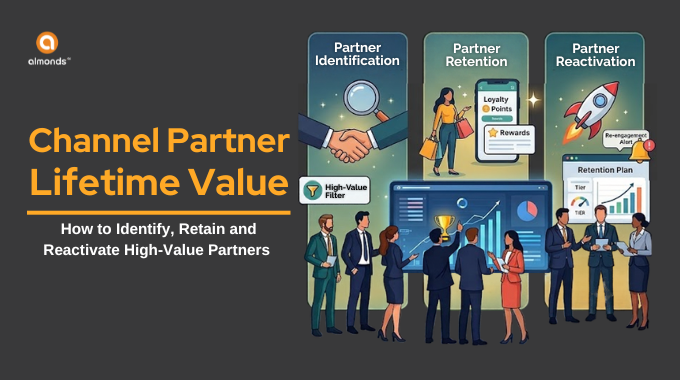

A channel partner generating ₹1 crore in annual sales is not automatically more valuable than one generating ₹60 lakh. The first partner may have declining sales, low margins, high servicing costs and a growing dependence on incentives. The second may be growing rapidly, selling a wider product mix, expanding its retailer network and generating stronger contribution margins.
This is why channel partner lifetime value needs to go beyond current sales. For brands working through dealers, distributors, retailers and other intermediaries, the more useful question is not simply “How much does this partner buy today?” but “How much profitable business can this partner create over the life of the relationship?”
That distinction becomes particularly important in India, where channel networks can account for a substantial share of business. An India-focused study covering more than 700 channel partners across six industries reported that distributors, dealers, retailers and influencers can contribute as much as 70–80% of annual sales for leading trade marketing brands.
The implication is straightforward: knowing which partners create long-term value can be as important as knowing which partners generate the most sales today.
What Is Channel Partner Lifetime Value?
Channel Partner Lifetime Value (LTV) is the estimated economic value that a dealer, distributor, retailer or other channel partner can generate for a brand over the duration of the commercial relationship.
The concept is related to customer lifetime value, but the channel context requires a broader view. A channel partner may generate direct revenue while also influencing retailer coverage, product availability, secondary sales, market expansion, and the adoption of new products. A simple starting point is:

However, this should not be treated as a universal formula. A more useful calculation considers contribution margin, retention probability, growth potential and the costs associated with servicing and incentivizing the partner. For example:

Channel partner-specific costs can include discounts, incentives, servicing, sales-team effort, fulfilment, credit costs and loyalty-program expenses.
The objective is not to create a mathematically perfect number. It is to create a consistent way of comparing partner value and deciding where commercial resources should be invested.
Why Sales Volume Alone Can’t Identify Your Most Valuable Channel Partners
Most channel dashboards naturally start with revenue. Sales teams rank distributors by billing, dealers by purchases and retailers by order volume because these are easy numbers to access and compare.
The problem is that sales volume tells only part of the story. A high-volume distributor may require significant discounts, generate low contribution margins and purchase primarily during incentive periods. Another distributor with lower current sales may have stronger growth, better payment behaviour, broader SKU adoption and substantially more potential in its territory.
Harvard Business School research on lifetime value similarly emphasizes that lifetime-value analysis is intended to help businesses understand the future value of relationships and decide where investment should be directed, rather than relying only on historical transaction value.
For channel businesses, this means current revenue should be treated as one component of partner value, not the definition of partner value.
The 5 Factors That Determine Channel Partner Lifetime Value
A practical channel partner LTV model should combine current economics with future potential. Five factors are particularly useful for evaluating dealers and distributors.
1. Current Revenue Contribution
The first question is still important: how much business does the partner generate today?
Brands should examine not only annual sales but also purchase frequency, average order value, product categories purchased and changes in revenue over time.
A partner generating ₹80 lakh with steady growth represents a different opportunity from one generating the same amount while declining every quarter. Current revenue establishes the starting point, but it should not determine the entire partner strategy.
2. Partner Profitability
Revenue does not equal profit. Two distributors can generate identical sales but produce very different contribution margins after discounts, incentives, servicing costs, logistics and other partner-specific expenses.
This is why channel partner profitability should sit alongside revenue when calculating lifetime value. A useful partner profitability view can include:

The exact cost structure will differ by industry, but the principle is consistent: the value of a partner depends on what the relationship contributes to the business, not simply what the partner purchases.
3. Growth Potential
A partner’s future potential can be more important than its current size. A dealer operating in a growing territory, adding new product categories and expanding its retailer or customer base may have considerably more future value than a larger partner operating in a mature territory with limited headroom.
Growth potential can be assessed through indicators such as category opportunity, territory coverage, SKU penetration, purchase frequency, outlet expansion and historical growth.
This is where channel partner segmentation becomes useful. Partners should not be evaluated only against their own previous sales; they should also be evaluated against the opportunity available to them.
4. Retention Probability
A partner can have high current revenue and still represent a significant risk if its engagement and purchasing behaviour are deteriorating.
Recent purchase trends, order frequency, product breadth, sales-team interactions and competitive movement can help identify whether a valuable relationship is becoming less stable. Research into B2B churn has found that behavioural measures such as recency, frequency and monetary value can help identify accounts at risk, while relationship activity can add further predictive value.
This makes channel partner retention part of the LTV calculation. A partner with strong current economics but a high probability of becoming inactive may require more immediate attention than a smaller partner with stable behaviour.
5. Strategic Value
Some partners contribute value that is not immediately visible in their purchase figures.
A distributor may provide access to an important territory. A dealer may influence recommendations among contractors or end customers. A retailer may provide strong visibility in a strategically important market. An influencer or installer may affect product preference far beyond their direct transactions.
Strategic value should therefore be considered alongside financial value.
This does not mean every influential partner should automatically receive greater investment. It means brands should recognize that partner value can include market access, influence, coverage and future opportunity—not just current billing.
How to Identify High-Value Channel Partners
Once these factors are combined, brands can create a more useful view of their partner network.
A simple Channel Partner Value Matrix can classify partners using current value and future potential:
| Partner Segment | Current Value | Future Potential | Strategic Approach |
| High Value, High Potential | High | High | Protect and grow |
| High Value, Low Potential | High | Low | Retain efficiently |
| Low Value, High Potential | Low | High | Develop selectively |
| Low Value, Low Potential | Low | Low | Automate and manage efficiently |
This is not an industry-standard classification; it is a practical way to translate partner data into resource allocation.
The important point is that high-value does not always mean high-revenue. A partner’s growth potential, profitability, retention probability and strategic role can change how much attention that relationship deserves.
Which Channel Partners Should Brands Prioritize?
The answer should depend on both partner value and risk.
A high-value distributor whose purchase frequency has fallen sharply deserves a different intervention from a low-value retailer that has been inactive for one purchase cycle. Similarly, a growing dealer with relatively low current revenue may deserve investment because its future potential is significant.
This creates a second useful dimension for channel teams: value × risk.
High-value, high-risk partners require immediate attention. High-value, low-risk partners should be protected and developed, while low-value, low-risk partners can often be managed through lower-cost, automated engagement.
The objective is not to give every partner the same experience. It is to allocate channel investment according to the economic importance and future potential of each relationship.
How to Retain High-Value Channel Partners
Retaining high-value channel partners does not always mean increasing incentives.
The reason a valuable partner is considering another brand may be commercial, operational, relational or market-driven. If the issue is poor product availability, a larger reward will not solve it; if the issue is weak margins, recognition alone will not change the economics.
A stronger dealer retention or distributor retention strategy should therefore examine four areas.
Commercial value
Review margins, incentives, growth opportunities, product economics and competitiveness.
Operational experience
Look at ordering, availability, delivery, claims, returns, payments and other friction points.
Relationship quality
Measure communication, recognition, account management and access to the brand.
Engagement
Use relevant learning, rewards, events, communication and personalized interactions where they can influence behaviour.
Research into channel partner engagement in India identified eight engagement drivers, including operational excellence, rewards and incentives, recognition, learning, brand affinity, communication, well-being and events.
The broader lesson is important: high-value partner retention is a relationship-economics problem, not simply an incentive problem.
How to Increase Channel Partner Lifetime Value
Once a brand knows which partners are valuable, the next question is how to increase their future contribution.
There are several commercial levers.
Increasing purchase frequency can raise annual revenue without necessarily requiring a larger partner base. Expanding product breadth can increase the value of each relationship by moving the partner from a single-category buyer to a broader brand partner.
Increasing share of wallet can be even more valuable in categories where dealers and distributors carry competing brands. If the partner allocates a larger portion of its category purchases to the brand, LTV can increase even when the overall market remains unchanged.
Brands can also increase partner value through new-product adoption, territory expansion, outlet activation and cross-selling. The right lever depends on the partner’s role and the constraints within its market.
The key is to identify the specific behaviour that can increase long-term contribution, rather than simply giving the partner more incentives.
How to Reactivate Dormant High-Value Channel Partners
A dormant partner is not necessarily a lost partner.
The first step in channel partner reactivation is understanding the partner’s history. A brand should examine previous revenue, product mix, purchase frequency, territory, profitability and the point at which the relationship began to decline.
The reason for inactivity matters just as much. A distributor that stopped purchasing because of stock availability requires a different intervention from one that shifted business to a competitor because of commercial terms.
This is where partner LTV becomes particularly useful.
A dormant partner that historically generated significant contribution and still has strong market potential may justify a focused reactivation effort. A low-value dormant partner with limited future potential may be better handled through a low-cost automated journey.
Reactivation Is Not the Same as One More Order
A common mistake is to define reactivation as a single transaction.
A dormant distributor may place one order after receiving a special incentive and then become inactive again. If the brand counts that transaction as a successful reactivation, it may overestimate the value of the intervention.
A better definition is sustained commercial recovery.
Brands can measure whether the reactivated partner places repeat orders, expands product coverage, returns to normal purchase frequency or maintains activity across subsequent cycles. This makes reactivation a measurable business outcome rather than a campaign metric.
How Data Helps Brands Measure Channel Partner Lifetime Value
Calculating partner LTV becomes difficult when the required information sits across disconnected systems.
Sales transactions may sit in a DMS or ERP. Partner profiles may exist in a CRM. Loyalty activity may be stored separately, while sales-team interactions and field activity may exist in another system.
A more complete partner-value view connects these signals:
Transaction Data + Partner Profile + Engagement + Incentive Cost + Sales Activity + Retention Behaviour
The result is a richer picture of partner economics.
Instead of seeing that a distributor generated ₹80 lakh last year, the brand can see that the distributor generated ₹80 lakh, delivered a particular contribution margin, grew or declined at a specific rate, covered a certain territory, purchased a certain range of products and is showing particular retention signals.
That information changes the question from “Who sold the most?” to “Who creates the most valuable and sustainable relationship?”
Why Channel Partner LTV Should Be Measured at the Partner Level
Average channel performance can hide important differences between individual partners.
Suppose a network generates 15% growth overall. That number may look healthy, but it could be driven by a small number of large distributors while hundreds of smaller partners are declining.
Partner-level LTV analysis makes those differences visible.
It allows brands to identify which partners are growing, which are declining, which have untapped potential and which require disproportionate servicing costs. This is particularly useful for large networks where sales teams cannot manually review every partner with the same level of detail.
The result is a more targeted channel partner strategy.
Channel Partner Lifetime Value vs Channel Partner Revenue
These two metrics should not be treated as interchangeable.
Channel partner revenue tells you how much business a partner generates within a defined period. Channel partner lifetime value attempts to estimate the economic value of that relationship over time.
A partner can therefore have high current revenue but relatively low expected LTV if retention probability is weak, margins are low and growth potential is limited.
Conversely, a smaller partner can have higher potential LTV if it has strong growth, healthy margins, high retention probability and significant room to expand.
This distinction is one reason why brands should avoid building their entire channel strategy around current sales rankings.
What Should a Channel Partner LTV Dashboard Measure?
A useful channel partner lifetime value dashboard should combine financial, behavioural and relationship indicators.
At a minimum, brands should consider:
- Current revenue
- Contribution margin
- Purchase frequency
- Average order value
- Product or SKU breadth
- Share of wallet
- Revenue growth
- Territory or outlet coverage
- Incentive and servicing cost
- Retention probability
- Engagement trends
- Reactivation status
- Growth potential
The dashboard should not simply produce a single “partner score” and stop there. Its real purpose is to help the sales and channel team decide where to invest, whom to protect, whom to develop and whom to reactivate.
How AI Can Improve Channel Partner Lifetime Value
AI becomes useful when it helps brands move from historical reporting to forward-looking partner decisions.
A traditional dashboard may show that a distributor’s sales declined by 18%. A predictive system can combine that decline with order frequency, SKU changes, engagement, territory behaviour and other signals to identify whether the partner is becoming a retention risk.
AI can also support partner segmentation and next-best-action recommendations. For example, one partner may need a commercial intervention, another may need product training, while a third may need a targeted reactivation campaign.
The important point is that AI should not simply automate more messages or rewards. Its value lies in helping brands understand which partner deserves attention, why the relationship is changing and what action has the greatest potential commercial impact.
How Channel Partner LTV Changes Loyalty Strategy
Lifetime value changes the way brands think about loyalty programs.
Instead of giving every partner the same reward structure, brands can connect investment to partner economics and desired behaviours. High-value partners may need retention and recognition, high-potential partners may need development, and dormant high-value partners may need targeted reactivation.
This also helps reduce unnecessary incentive spending.
A reward should have a purpose: retain a valuable partner, increase share of wallet, encourage a profitable behaviour, accelerate product adoption or reactivate a commercially important relationship. When the objective is clear, brands can measure whether the incentive actually increased partner value.
That moves loyalty from “How many points did we distribute?” to “Did our investment increase the value of the partner relationship?”
From Partner Ranking to Partner Strategy
The purpose of measuring channel partner lifetime value is not to create another leaderboard.
The purpose is to make better decisions about where sales resources, incentives, engagement programs and account-management effort should be allocated.
A high-value partner at risk of churn needs protection. A high-potential partner needs development. A dormant but historically valuable partner needs reactivation, while a low-value partner with limited potential may need a more efficient, automated approach.
This is where partner analytics becomes a business strategy rather than a reporting exercise.
A Practical Channel Partner LTV Framework
A simple way to operationalize the approach is:
Measure → Segment → Predict → Act → Recalculate
- Measure: Establish current revenue, contribution, purchase behaviour and servicing costs.
- Segment: Group partners according to current value and future potential.
- Predict: Identify retention risk, growth potential and likely changes in partner value.
- Act: Allocate the right commercial, operational or engagement intervention.
- Recalculate: Measure whether the partner’s value actually changed after the intervention.
The final step matters because partner value is not static. A partner who was highly valuable two years ago may no longer be so, while a smaller partner can become strategically important as its market expands.
Conclusion: The Most Valuable Channel Partner Is Not Always the Biggest
Channel partner lifetime value gives brands a more complete way to understand the economics of their dealer and distributor relationships.
Current sales remain important, but they are only one part of the picture. Profitability, growth potential, retention probability, strategic value and the cost of maintaining the relationship can materially change how a partner should be prioritized.
For brands managing thousands of dealers, distributors and retailers, the objective is not to treat every partner equally. It is to identify which relationships create the greatest current and future value, which are at risk, and where targeted investment can increase that value over time.
The most useful question is therefore not:
“Which partner sells the most today?”
It is:
“Which partners can create the most profitable and sustainable value for the brand over the life of the relationship?”
That is the question that turns channel partner lifetime value from a reporting metric into a channel growth strategy.
Frequently Asked Questions
What is channel partner lifetime value?
Channel Partner Lifetime Value (LTV) is the estimated economic value a dealer, distributor, retailer, or other channel partner can generate for a brand over the duration of the relationship. It considers more than current revenue and can include profitability, retention, growth potential, strategic value, and partner-specific costs.
How do you calculate channel partner lifetime value?
A simple starting point is Average Annual Contribution × Expected Relationship Duration. A more complete model can incorporate contribution margin, retention probability, growth potential and costs such as incentives, discounts, servicing and fulfilment.
Why is channel partner lifetime value important?
Channel partner LTV helps brands decide where to allocate retention, sales and engagement resources. It prevents brands from evaluating partners solely on current sales and helps identify relationships with stronger long-term commercial potential.
What is the difference between channel partner revenue and lifetime value?
Channel partner revenue measures the business generated during a particular period. Channel partner lifetime value estimates the economic value of the relationship over time, including profitability, retention, growth potential and relevant costs.
How do you identify high-value channel partners?
High-value channel partners can be identified by combining current revenue, profitability, growth potential, retention probability and strategic importance. This creates a more complete picture than ranking dealers or distributors only by sales volume.
How can brands increase channel partner lifetime value?
Brands can increase partner LTV by improving purchase frequency, expanding product or SKU adoption, increasing share of wallet, improving retention, activating new territories or outlets and developing high-potential partners. The specific growth lever should depend on the partner’s role and market opportunity.
How can brands retain high-value channel partners?
Channel partner retention should address the reason the partner may become less active. Depending on the situation, this can involve commercial improvements, better operational support, stronger communication, recognition, training, targeted rewards or account-management interventions.
How do you reactivate dormant channel partners?
Start by identifying the dormant partner’s historical value, previous behaviour, reason for inactivity and future potential. High-value dormant partners can then receive targeted reactivation strategies, with success measured through sustained repeat business rather than a single post-campaign order.
What is dealer lifetime value?
Dealer lifetime value is the estimated economic contribution a dealer can generate for a brand over the duration of the relationship. It can include sales, margin, retention, product adoption, customer influence, growth potential and the cost of serving the dealer.
What is distributor lifetime value?
Distributor lifetime value estimates the long-term economic value of a distributor relationship. In addition to sales and margins, it may consider territory coverage, retailer reach, product breadth, purchase frequency, market expansion and the cost of maintaining the relationship.
How can AI help measure channel partner lifetime value?
AI can combine transaction, engagement, partner and sales data to identify patterns in partner value and retention risk. It can help brands segment partners, identify changes in behaviour and recommend differentiated actions, although the quality of the output depends on the underlying data and business definitions.
Should every channel partner receive the same loyalty benefits?
Not necessarily. Partner value, growth potential and retention risk can differ substantially, so a differentiated approach can help brands allocate rewards and engagement investment more efficiently.
How is channel partner LTV connected to loyalty programs?
LTV can help determine where loyalty investment is commercially justified. Instead of rewarding every partner equally, brands can design interventions around retaining high-value relationships, developing high-potential partners, increasing valuable behaviours and reactivating commercially important dormant partners.