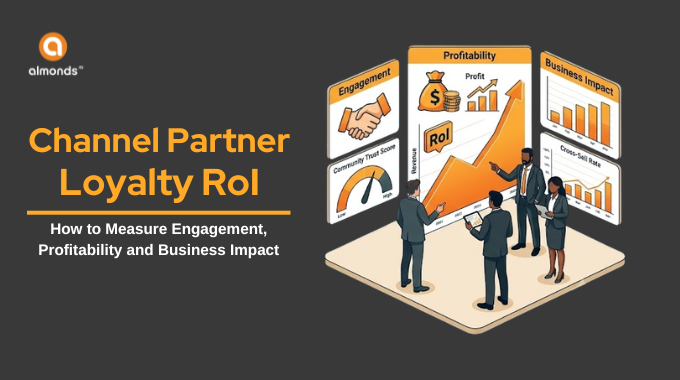

A channel partner program can have high participation, strong redemption and impressive sales growth and still deliver poor ROI. That is because activity is not the same as impact. A partner may participate because the reward is attractive, while the sales increase may have come from market growth, pricing, seasonality, a new product, additional distribution or factors that would have existed without the program.
For a business leader, the more important question is not “Did the partners participate?” It is: How much additional business value did the program create compared with what the company invested in it? That distinction changes how channel partner ROI should be measured.
The strongest programs connect partner behaviour to business outcomes, isolate the incremental effect where possible, and evaluate the economic return after accounting for the full cost of the intervention.
What Does Channel Partner ROI Actually Mean?
Channel partner ROI measures the economic return generated by an investment made to influence the behaviour or performance of independent channel partners. That investment can include incentives, rewards, rebates, partner programs, technology, communications, training, program management and other associated costs.
The important word is investment. A channel program should not be judged only by whether sales increased during the period in which it was running. The analysis needs to establish whether the program produced enough incremental economic value to justify the investment.
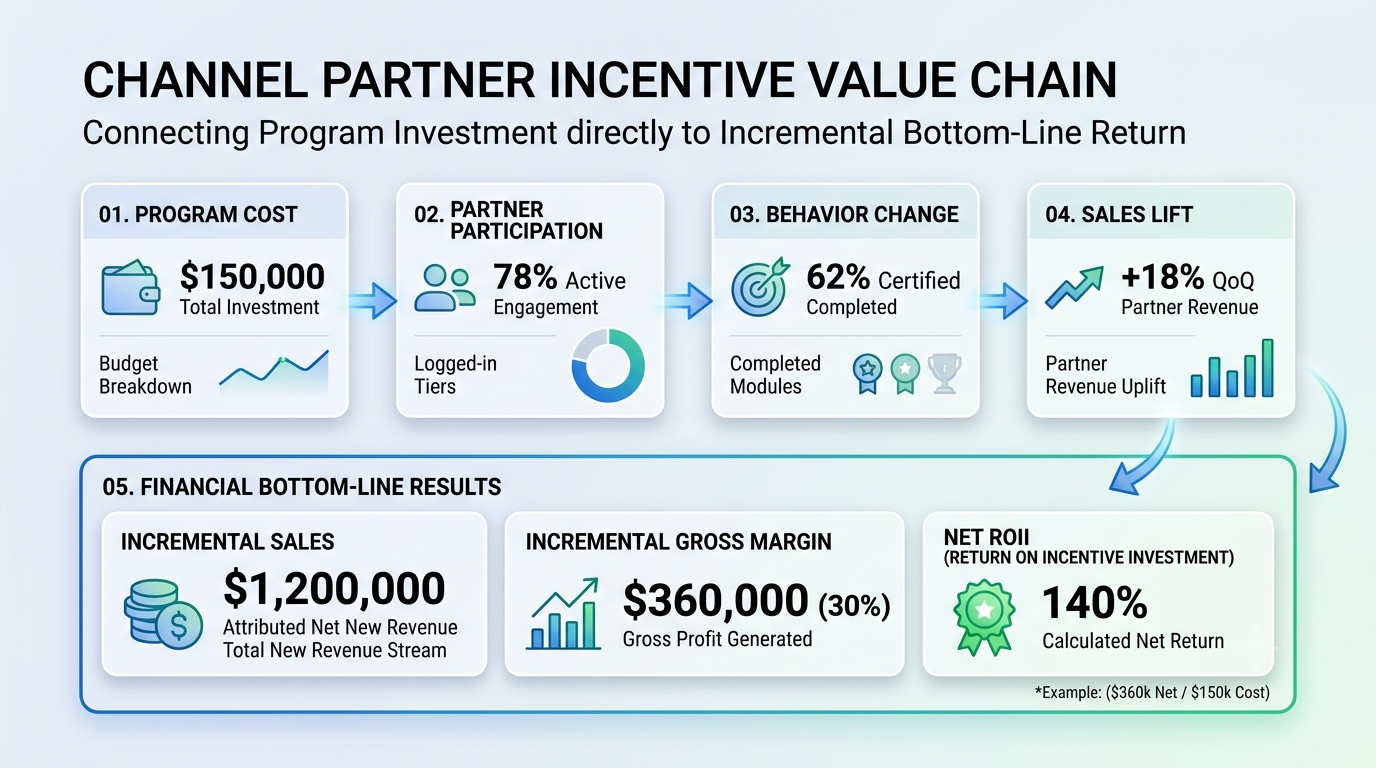
A useful way to think about the measurement chain is:
Investment → Channel Partner Behaviour → Business Performance → Incrementality → Economic Return
This is also why engagement metrics such as registrations, logins, points earned or rewards redeemed are better treated as leading indicators, not proof of financial ROI.
The 2026 Incentive Research Foundation research on channel incentive programs makes the same distinction, identifying incremental gross margin as the primary financial measure while treating engagement, retention, tier progression and behavioural adoption as supporting indicators.
Why Channel Partner ROI Is Harder to Measure Than It Looks
Suppose a company launches a distributor incentive program in April. By September, participating distributors have increased sales by 15%. It is tempting to attribute the entire increase to the program. But several other things may have happened during those six months:
- The overall market may have grown.
- Competitors may have faced supply constraints.
- Prices may have increased.
- The company may have launched new products.
- Distribution may have expanded.
- The sales team may have increased field coverage.
- Seasonal demand may have been stronger.
- Large partners may already have been on a growth trajectory.
This is the central problem with channel ROI measurement: Correlation between a program and sales growth does not automatically establish causation.
The Incentive Research Foundation has identified causality as one of the central difficulties in measuring incentive-program ROI. Its research recommends comparison groups and field experiments where practical because they provide a stronger basis for estimating what would have happened without the intervention.
What Would Have Happened Without the Channel Program?
This is arguably the most important question in channel partner ROI measurement. Imagine two groups of comparable distributors.
Program group: sales increase by 18%
Comparison group: sales increase by 8%
The relevant result is not simply the 18% growth of the program group. The initial estimate of incremental lift is the difference between the two:
18% − 8% = 10 percentage points
If the program group’s baseline revenue was ₹10 crore:
Estimated incremental revenue = 10% × ₹10 crore = ₹1 crore
This is an illustrative calculation, not a universal attribution method. The quality of the estimate depends on how comparable the groups are and whether other differences affected their performance.
The IRF’s measurement guidance uses this same basic logic and recommends matched partners or regions where sufficient baseline data exists.
How Can Brands Measure Incremental Sales From a Channel Program?
There is no single measurement method that works for every channel. The right approach depends on partner volume, data quality, program design and the practical constraints of the business.
1. Matched partner or control group
Select partners that resemble the participating group in terms of size, geography, historical growth, product mix and other relevant characteristics. Then compare their performance during the program.
This is stronger than a simple before-and-after comparison because it gives the business a reference point for what may have happened without the intervention. It still does not create perfect causal proof, but it improves the quality of the comparison.
2. Eligible participants vs non-participants
Some programs have eligible partners who choose not to participate. Comparing participants with these non-participants can be useful, especially when controlled experiments are not possible. There is, however, an important weakness: self-selection.
Partners who are already more motivated may be more likely to participate. Their superior performance may therefore partly reflect who they were before the program, rather than what the program caused.
3. Geographic holdouts
For a geographically distributed business, selected regions can sometimes be used as comparison markets. For example, a brand could run a new channel initiative across 70% of comparable territories while retaining 30% as a measurement holdout, provided the commercial and relationship implications are acceptable.
This can be particularly useful when individual partners cannot realistically be excluded from a program.
4. Randomized field experiments
Random assignment provides stronger evidence because the treatment and control groups are created systematically.
In channel businesses, however, this can be difficult. Partners may learn about the incentive, question why they were excluded or change their behaviour because they know an experiment is taking place. The IRF therefore notes that randomized assignment offers strong evidence but is rarely appropriate unless relationship and leakage risks can be managed.
5. Baseline and trend projection
When a control group is not possible, brands can estimate expected performance using historical trends and compare actual results against that baseline.
This is weaker than a controlled comparison because market conditions may have changed. But it is still more disciplined than assuming that every increase after a program launch was caused by the program.
How Do You Calculate Channel Partner ROI?
ROI = (Incremental Return − Program Cost) ÷ Program Cost × 100
The difficult part is defining incremental return correctly.
For channel programs, revenue is often a poor final measure because ₹1 crore of additional sales does not mean ₹1 crore of additional economic value. A better financial measure is contribution or gross margin.
Incremental Margin ROI = (Incremental Gross Margin − Program Cost) ÷ Program Cost
The 2026 IRF channel research identifies Incremental Gross Margin per Incentive Dollar as its primary financial measure for channel incentive programs. Consider a simplified example. A program produces:
- ₹2 crore incremental revenue
- ₹50 lakh incremental gross margin
- ₹20 lakh total program cost
Then:
ROII = (₹50 lakh − ₹20 lakh) ÷ ₹20 lakh = 150%
The business generated ₹30 lakh more gross margin than the program cost. This is much more informative than saying: “The program generated ₹2 crore in sales.”
What Costs Should Be Included in Channel Partner ROI?
This is where many ROI calculations become misleading. If the analysis counts only rewards while ignoring the rest of the investment, the return can look artificially attractive. Depending on the program, total investment may include:
| Cost component | Why it matters |
| Rewards and incentives | Direct participant cost |
| Rebates or discounts | Reduces economic return |
| Technology/platform | Enables program delivery |
| Program management | Operational cost |
| Communications | Required to activate participation |
| Fulfilment | Cost of delivering rewards |
| Data integration | May be necessary to measure performance |
| Additional sales servicing | Relevant where the program creates incremental service requirements |
| Training or activation | Cost of changing partner behaviour |
Not every cost should automatically be allocated to every ROI calculation. The important principle is to define the cost boundary before measuring the return and use it consistently. A program that looks profitable only because several material costs were excluded is not producing reliable ROI.
Engagement Is Not ROI: Which Metrics Should Be Connected?
A strong channel measurement system should connect metrics across the journey from participation to financial impact.
| Measurement layer | Examples | What it tells you |
| Engagement | Participation, logins, redemptions | Are partners interacting? |
| Behaviour | SKU adoption, training, outlet activation, purchase frequency | Is behaviour changing? |
| Performance | Sell-in, sell-out, coverage, growth | Is commercial performance changing? |
| Economics | Gross margin, contribution, program cost | Is the change financially valuable? |
| Incrementality | Lift vs baseline/control | How much change can reasonably be attributed to the program? |
The distinction matters. A partner redeeming ₹10,000 worth of rewards tells you something about participation. It does not tell you whether the brand generated ₹10,000, ₹50,000 or ₹1 lakh of incremental economic value. Likewise, higher partner engagement can be a useful signal without being the final business outcome.
Why the Highest-Performing Partners May Not Offer the Highest ROI
It is easy to assume that the biggest partners deserve the largest investment. That is not always true. A top partner may already have substantial market share and strong demand. Spending another ₹10 lakh to influence that partner may produce relatively little additional growth. A middle-tier partner, by contrast, may have enough market capability to grow substantially if the right behaviour changes.
The 2026 IRF channel research specifically identifies the middle 60% of partners as a potential area of significant ROI opportunity. Its finding is not that every business should target exactly 60%, but that moving capable middle-tier partners upward can sometimes generate growth without the premium cost required to extract additional performance from already dominant partners. This suggests a more useful allocation logic:
| Partner Group | Current Position | Potential Investment Strategy |
| Top performers | High performance | Protect, retain and deepen |
| Middle performers | Moderate performance | Identify and accelerate |
| Emerging partners | Lower current value, potential upside | Develop selectively |
| Low-value/low-potential | Low performance and limited opportunity | Automate or reduce cost-to-serve |
The objective is not to spend equally across the network. It is to identify where the next unit of investment can create the greatest incremental value.
Can a Channel Incentive Program Have High Sales Growth but Negative ROI?
Yes.
A program can increase sales and still destroy economic value if the cost of creating those sales is too high. For example:
- Incremental revenue: ₹1 crore
- Incremental gross margin: ₹18 lakh
- Rewards and program costs: ₹22 lakh
- Sales increased, but the program produced: ₹18 lakh − ₹22 lakh = −₹4 lakh
The program created additional revenue but negative incremental economic value. The opposite can also happen. A smaller increase in revenue can produce stronger ROI if the business has healthy margins and the intervention is inexpensive.
That is why revenue growth should be treated as an outcome metric, not automatically as the return itself.
Why a Successful Reward Program Can Still Damage the Channel
ROI should also account for what happens elsewhere in the network.
A 2021 Journal of Business Research study involving 304 distributors across multiple industries in China examined the unintended effects of channel rewards. It found that larger supplier rewards could increase competitive intensity among distributors, which could in turn encourage opportunistic behaviour among distributors who did not receive the reward.
This matters because a program can look successful when viewed only through the rewarded partner. But the broader network may experience:
- Unhealthy competition
- Channel conflict
- Opportunistic behaviour
- Partner dissatisfaction
- Reward chasing
- Short-term purchasing behaviour
The lesson is not that rewards are harmful. It is that program ROI should be evaluated at network level where the intervention can affect other partners. A high-performing program should create profitable behaviour without creating a larger problem somewhere else in the channel.
ROI Starts With Program Design, Not the Final Calculation
Measurement cannot rescue a poorly designed program. If the program rewards a behaviour that is easy to manipulate, the resulting ROI calculation may measure gaming rather than genuine business growth.
A 2016 study of 252 firm–channel partner dyads across automobile firms in India found that channel partner performance has three distinct dimensions: output performance, activity performance and capability performance. That distinction is useful when designing measurement. A program may reward an output such as sales, but the business may also need to influence:
- Productive Outlet Development
- Product Knowledge
- New-SKU Adoption
- Service Capability
- Sales Process Compliance
- Market Development
The right question is therefore: Which partner behaviour should change first, and which measurable business outcome should that behaviour eventually influence? That makes the ROI model more causal rather than simply retrospective.
How to Build a Channel Partner ROI Dashboard
A useful dashboard should connect financial investment to the behaviour and outcomes it was designed to change.
At minimum, the dashboard should show:
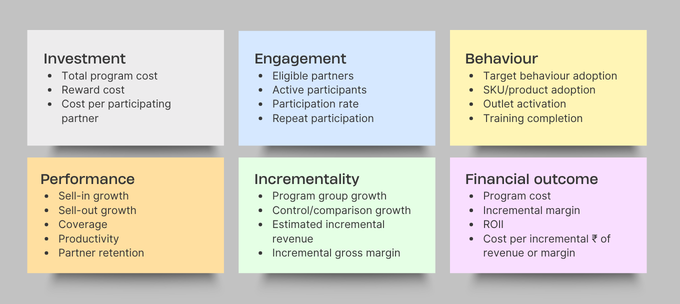
The important feature is not the number of metrics. It is the ability to trace:
We spent this much → This behaviour changed → This business outcome changed → This much of that change was incremental → This was the financial return.
How Often Should Channel Partner ROI Be Measured?
ROI should not be calculated only when the annual budget review arrives. A better approach is to separate operational monitoring from financial evaluation.
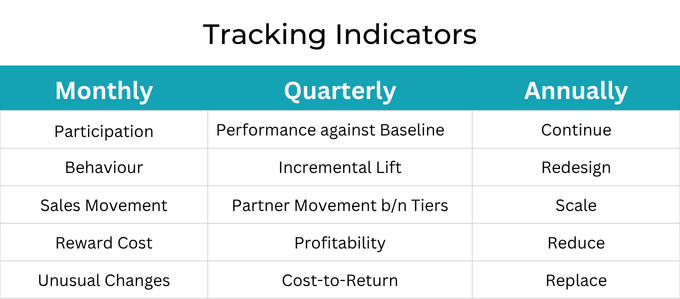
The exact cadence should depend on the sales cycle. A program selling high-value industrial equipment cannot be evaluated on the same time horizon as a fast-moving consumer category.
What Should Finance, Sales and Marketing Agree on Before Launch?
One of the easiest ways to make ROI measurement difficult is to start measuring after the program has already started. Before launch, the teams should agree on:
- What business problem is the loyalty program solving?
- Which channel partner behaviour should change?
- What commercial outcome should that behaviour influence?
- What is the baseline?
- How will incrementality be estimated?
- Which costs belong in the investment calculation?
- Which financial metric determines success?
- Who owns the underlying data?
- When will the loyalty program be reviewed?
- What happens if the expected return does not materialise?
This turns ROI from an end-of-year reporting exercise into part of the program’s original design.
Frequently Asked Questions
What is channel partner ROI?
Channel partner ROI measures the economic return generated from investments made to influence channel partner behaviour or performance. A meaningful calculation should consider incremental business value and the cost of generating that value, rather than participation or revenue growth alone.
How do you calculate channel partner ROI?
A basic formula is:
ROI = (Incremental Return − Program Cost) ÷ Program Cost × 100
For channel incentive programs, incremental gross margin can provide a more useful financial measure than revenue because it accounts for the economic value retained after generating additional sales.
What is incremental sales in channel marketing?
Incremental sales are the additional sales attributable to a channel intervention above the sales that would reasonably have occurred without it. Estimating them typically requires a baseline, comparison group, holdout market or another method of estimating the counterfactual.
How do you measure the incremental impact of a channel incentive program?
Brands can use matched partner groups, geographic holdouts, participant vs. non-participant comparisons, randomized experiments, or historical trend projections. The strongest method depends on the available data and practical constraints of the channel.
What is the difference between revenue ROI and margin ROI?
Revenue ROI focuses on additional sales generated relative to investment. Margin ROI considers the incremental gross margin or contribution created after generating those sales, making it more useful when discounts, incentives and other variable costs materially affect profitability.
What costs should be included in channel partner ROI?
Depending on the program, costs can include rewards, rebates, technology, program management, communications, fulfilment, data integration and incremental servicing costs. The cost boundary should be defined before measurement and applied consistently.
How can brands prove that a loyalty or incentive program increased sales?
The strongest approach is to compare participating partners with a credible control or comparison group. The objective is to determine how much more the program group grew than a similar group that was not exposed to the intervention.
Can a channel incentive program have high sales growth but negative ROI?
Yes. If the incremental gross margin generated by the additional sales is lower than the total cost of the incentives and program, the program can increase revenue while producing negative economic ROI.
Which channel partners should receive the most incentive investment?
The answer depends on both current value and growth potential. Top partners may need retention investment, while middle-tier partners can sometimes provide greater incremental growth opportunities if they have the capability and market potential to improve.