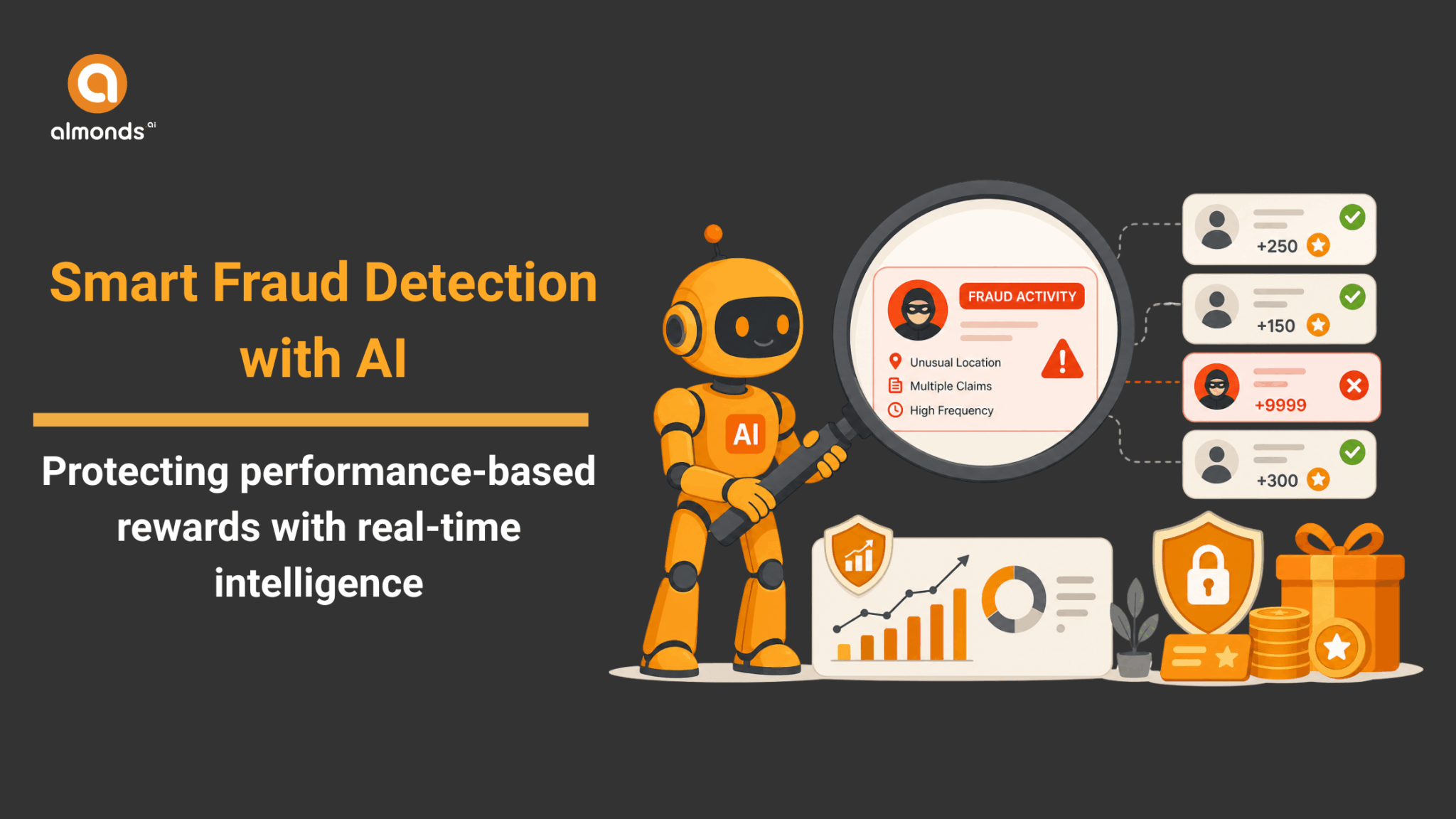

Loyalty programs to channel partners, retailers, distributors, stockists, and dealers in the current competitive B2B ecosystem have developed well beyond simple points and discounts.
Modern programs are performance-based, data-driven, and closely tied to business outcomes like sell-out growth, product mix improvement, and market expansion.
But, as the size and complexity of these programs increase, the risk of fraud increases as well. False claims, falsified invoices, redemption duplications, and channel collusion can silently loyalty budgets often without on-the-fly detection. This is where AI-enabled fraud detection is an essential facilitator of sustainable, high-ROI B2B loyalty programs.
Why Is Fraud an Emerging Concern in B2B Loyalty Programs?
B2B loyalty programs work between different layers, unlike consumer loyalty, which focuses on distributors, retailers, field sales teams, and third-party partners. This complexity provides several vulnerability points:
- Paper-based submissions of claims and uploading of invoices.
- Late data reconciliation of sell-in and sell-out.
- Monotonous patterns of rewards among unrelated partners.
- Misuse of incentives in proxy accounts.
- Distorted reporting of performance to receive greater awards.
Checks or post-facto audits that are based upon rules are no longer sufficient. They are responsive and slow and can be evaded, particularly when the volumes of incentives are in crores.
How AI Revolutionizes Fraud Detection in Performance-Based Rewards?
AI-based fraud detection systems are not limited to fixed rules. They get to know how to act, adjust on the fly, and keep on polishing their perceptions of what normal is to each partner.
1.Behavioral Pattern Analysis
AI constantly analyzes past and current partner behavior, including the frequency of claims, sales pace, redemption composition, and seasonal data. Where the activity of a retailer or distributor suddenly does not follow his or her routine without a legitimate business cause, the system sounds an alarm that is further examined.
2.Scalable Anomaly Detection
AI detects nuanced anomalies that are not always detected during manual checks. They consist of the same claim behaviors in retailers at a long distance, a redemption repeated within the fraction of a point of approval, scheme-end spikes, or velocity of reward not matched by market size indicators that can be innocent in isolation but indicative of abuse when combined.
3.Cross-Partner Network Intelligence
AI does not analyze partners in isolation but the whole channel network. It identifies concealed relationships, coordinated conduct, and possible collusion among distributors, retailers, and the internal team, particularly in sophisticated B2B ecosystems with mutual systems and informal associate systems.
4.Real-Time Risk Scoring
AI calculates dynamic risk scores on each claim and partner dynamically. Low-risk transactions are automatically approved, medium-risk transactions are automatically sent to be reviewed, and high-risk transactions are automatically blocked immediately—it ensures a faster payout to true partners and ensures high control over fraud.
Protecting Trust Without Slowing Down the Channel
It is one of the largest fears that brands have, as stricter control over fraud can slow down reward fulfillment or frustrate channel partners.
AI solves this paradox. With attention concentrated on the risky spots, AI-based systems are certain to guarantee the following:
- True partners are rewarded sooner.
- Trust remains intact.
- There is a decreased manual intervention.
- The engagement of channels actually gets better.
Loyalty programs would be relationship building, not merely incentives, when fairness and transparency are observed by the partners.
AI Fraud Detection as a Strategic Advantage
Beyond cost savings, AI-driven fraud detection delivers strategic value:
- Improved ROI on loyalty spend
- Accurate performance insights for decision-making
- Cleaner data for future incentive design
- Scalable governance across regions and partner tiers
It also enables brands to confidently launch more innovative reward models, such as real-time incentives, gamified milestones, and hyper-personalized schemes without fear of misuse.
How Almonds.ai Enables Smarter, Safer Loyalty Programs?
At Almond AI, fraud detection is not an add-on, and it is built into the core of performance-based B2B loyalty design.
By combining AI, behavioral analytics, and real-time intelligence, Almond AI helps brands:
- Detect and prevent loyalty fraud proactively
- Protect incentive budgets without hurting partner experience
- Maintain transparency and trust across channel networks
- Scale loyalty programs confidently across geographies
The platform continuously learns from partner behavior, ensuring that fraud detection evolves alongside your channel ecosystem.
Conclusion
Operational risk is no longer a concern in performance-based B2B loyalty programs but a strategic risk. The brands, whose controls are based on outdated ones, are likely to lose money and the trust of partners.
Fraud detection powered by AI provides a solution that is both intelligent and adaptive and partner-friendly in the future. To be truly committed to developing sustainable, high-impact loyalty programs with retailers and distributors, AI is no longer a luxury but a necessity. Learn how Almond AI assists brands in creating secure, intelligent, and scalable B2B loyalty programs without losing partner trust.
FAQs
1. How does AI differentiate between genuine high performers and fraudulent behavior?
AI models evaluate performance in context, comparing current activity against historical behavior, peer benchmarks, seasonal trends, and market potential. This multi-dimensional analysis ensures high-performing retailers or distributors are rewarded without being wrongly flagged as fraudulent.
2. Can AI fraud detection work across complex, multi-tier channel structures?
Yes. AI is designed to analyze behavior across distributors, retailers, sub-stockists, and field teams simultaneously. It identifies irregularities and coordinated patterns across tiers, offering network-level visibility that traditional, partner-by-partner evaluations cannot achieve.
3. Does AI-driven fraud detection slow down reward approvals for partners?
On the contrary, it accelerates approvals. By auto-clearing low-risk claims and focusing manual review only on high-risk cases, AI significantly reduces processing delays while maintaining transparency and fairness across the channel ecosystem.
4. How does AI adapt when incentive structures or schemes change?
AI continuously learns from new data. As schemes, reward mechanics, or partner behaviors evolve, the system recalibrates risk models dynamically—eliminating the need for frequent manual rule updates and ensuring consistent fraud detection effectiveness.
5. What business impact does AI-driven fraud detection deliver beyond cost savings?
Beyond preventing misuse, AI improves data integrity, strengthens partner trust, enhances ROI measurement, and enables brands to confidently scale innovative, performance-based loyalty programs without increasing governance complexity or operational overhead.