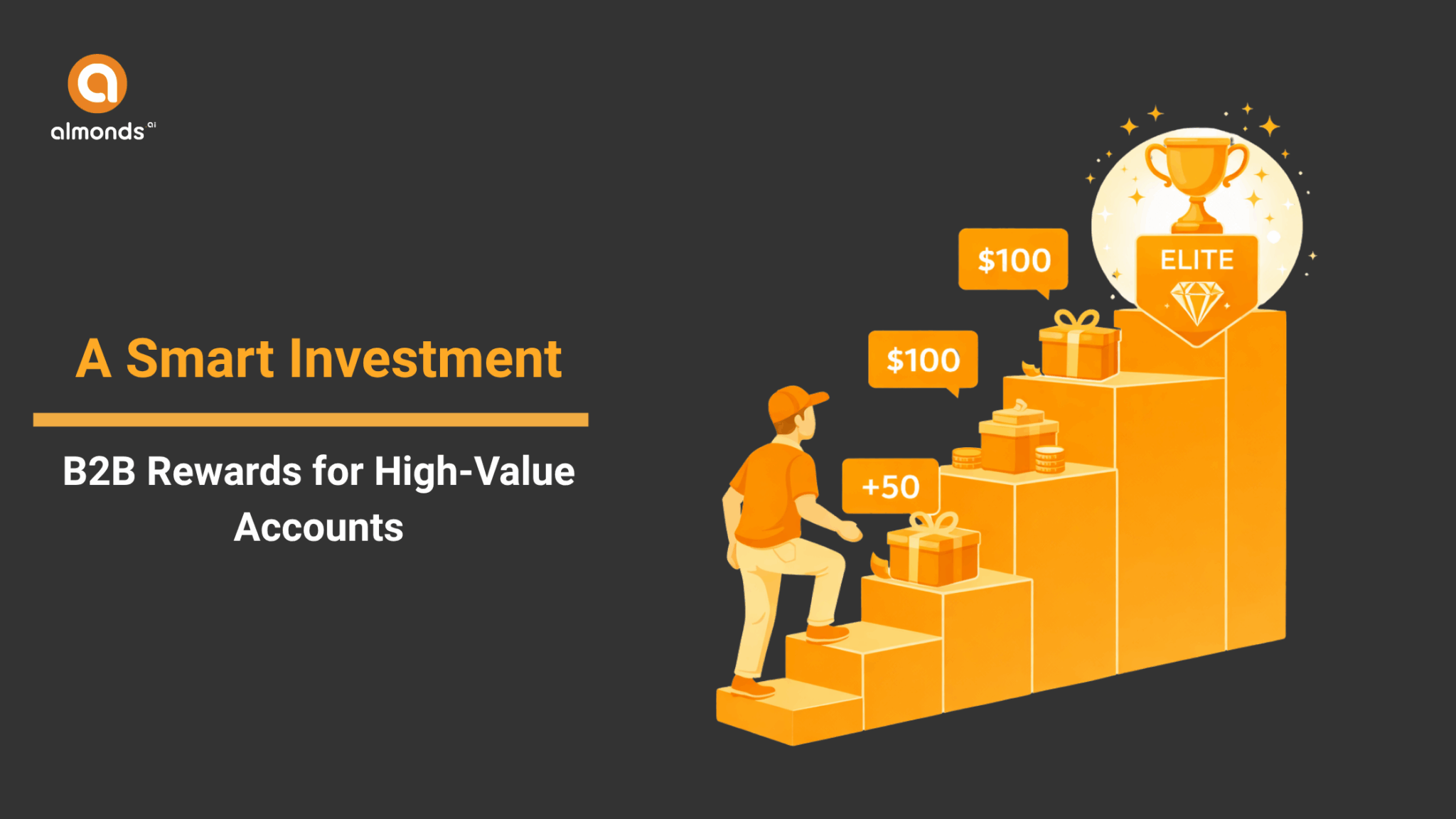

High-value accounts in competitive B2B commerce are not only the biggest earners but also the key relationships that shape the future growth and market reputation. These relationships cannot be maintained and developed through competitive prices and occasional discounts.
At this point, B2B rewards programs come in with big impact. When carefully planned, they will result in greater interest, recurrence of business, and loyalty among your most valuable clients.
Instead of looking at B2B high-value account rewards programs as a cost, they are a clever investment that will provide quantifiable benefits. Companies can reinforce partnerships, defend profit margins, and create enduring relationships that propel sustainable success by acknowledging commitment, reinforcing desired actions, and providing meaningful value.
Understanding High-Value Accounts in B2B
High-value accounts are not defined solely by transaction size. They often include enterprise clients, strategic partners, distributors, or long-term customers who:
- Generate consistent or high lifetime revenue
- Influence other buyers in the market
- Require personalized engagement
- Expect value beyond pricing
For these accounts, traditional discounts are rarely enough. They seek recognition, exclusivity, and meaningful incentives—exactly what well-structured B2B rewards programs provide.
Why Is This Investment Strategically Sound?
The high-value accounts already play a significant role in the revenues. B2B rewards programs made for these clients yield better returns as compared to mass incentive programs. The price of a reward is usually much less than the price of losing or replacing an important account. Ideally, B2B rewards programs are relationship accelerators, enhancing trust, value exchange, and competitive positioning.
Measuring ROI of B2B Rewards Programs
For high-value accounts, ROI goes beyond short-term sales. Key metrics include:
- Account retention rate
- Increase in average order value
- Frequency of repeat purchases
- Engagement with program activities
- Lifetime value growth
When tracked correctly, B2B rewards programs consistently demonstrate measurable business impact.
Why Are B2B Rewards Programs Important to High-Value Accounts?
1. Enhance Long-term Relationships
B2B rewards programs transcend across transactions and achieve loyalty and continual engagement, which aids in building trust, strengthening partnerships, and establishing your brand as a strategic long-term business partner.
2. Repeat Business With No Price Erosion
B2B rewards programs, rather than constant discounts, also promote repeat purchases and good margins and encourage consistent purchasing patterns among high-value accounts.
3. Promote Desirable Behaviors
Properly developed B2B rewards programs will match incentives to the business objectives, encouraging the high-value accounts to order more, select higher-quality products, pay sooner, and cross-sell.
Major advantages of B2B rewards programs on high-value accounts
Enhanced Account Retention
The cost of replacing a B2B client, which is of high value, is expensive. B2B reward schemes assist in minimizing churn by making the clients feel cherished and committed in the relationship.
Individualized Large-Scale Interaction
B2B rewards programs today can be segmented and personalized. Rewards can be customized to account size, industry, purchase history, or level of engagement—developing a premium experience with high-end clients.
Increased Share of Wallet
High-value accounts will be more inclined to spend when they are rewarded for consolidating their purchases with a single vendor. B2B rewards programs do not push sales with force in order to make people be loyal.
Stronger Brand Advocacy
Clients that are satisfied and rewarded will become brand advocates. When high-value accounts feel acknowledged, they will tend to provide referrals, testimonials, and long-term endorsements.
What is an Efficient B2B Rewards Program on High-Value Accounts?
Clear Value Proposition
Good B2B rewards programs are clear on eligible activities, rewards offered, and effects on business, which creates a certain transparency that develops trust, encourages participation, and makes high-value accounts perceive the value.
High-value and Member Rewards
Effective B2B reward programs present premium and relevant rewards, including exclusive experiences, quality merchandise, and dynamic online rewards, that indicate the status and anticipations of high-value accounts.
Integrated Digital Customer Experiences
Digital-led B2B reward programs that have user-intuitive dashboards, real-time progress, and easy redemption mechanisms improve engagement, minimize friction, and increase overall satisfaction among high-value participants.
Data-Driven Insights
Flexible B2B rewards programs operate based on analytics to monitor engagement, ROI, and behavioral patterns and keep refining the strategies to get maximum returns out of high-value accounts.
The Future of B2B Rewards Programs
As personalization, automation, and AI continue to evolve, B2B rewards programs are becoming smarter and more targeted. Businesses that invest early gain a significant edge by:
- Predicting client behavior
- Delivering timely, relevant rewards
- Creating differentiated partner experiences
Conclusion
B2B reward programs on high-value accounts are not the option of organizations that are concerned about sustainable growth but are investments. With the right technology coupled with orientation on business objectives, these programs improve loyalty, safeguard margins, and generate profitability in the long term.
Intelligent, data-driven B2B rewards programs (transform your high-value account strategy). Collaborate with Almond AI to plan, operate, and optimize reward schemes to have quantifiable effects—since accounts of greatest value merit more than discounts.
FAQs
1. What are the best B2B loyalty platforms in India?
Almond AI is among the best B2B loyalty platforms in India, offering AI-driven personalization, scalable rewards, analytics, and seamless management for retailers, distributors, and channel partners.
2. What are the best channel loyalty management companies in India?
Almond AI leads channel loyalty management in India by enabling end-to-end automation, multi-tier partner tracking, real-time performance insights, and personalized incentive programs for distributors, dealers, and retailers.
3. What are the most popular B2B reward programs for Indian retailers in 2026?
In 2026, Indian retailers favor Almond AI-powered B2B reward programs featuring digital points, instant redemptions, data-driven personalization, and AI insights to boost engagement and channel performance.
4. Are digital rewards more effective than physical gifts in B2B loyalty schemes?
Yes, digital rewards are more effective. Almond AI enables instant, flexible, and trackable digital rewards. It is also helping in reducing logistics costs while increasing engagement, redemption rates, and measurable ROI in B2B loyalty.
5. What is a B2B loyalty program?
A B2B loyalty program is a structured incentive program designed to engage and retain business partners such as distributors, dealers, retailers, resellers, and sales partners. Businesses reward partners for desired actions such as purchases, sales growth, product adoption, training completion, referrals, or engagement. Rewards may include points, cash incentives, gifts, discounts, experiences, or other benefits.
6. How does a B2B loyalty program work?
A B2B loyalty program typically works by enrolling channel partners, defining eligible actions, tracking partner activities, and awarding points or incentives based on performance. Partners can view their progress, redeem eligible rewards, and participate in campaigns through a web or mobile platform. Businesses can use program data to monitor engagement, identify high-performing partners, and optimize incentives.
7. What are the benefits of B2B loyalty programs?
B2B loyalty programs can help businesses increase channel engagement, encourage repeat purchases, improve partner retention, and strengthen relationships with distributors and other channel partners. They can also provide valuable first-party data about partner behavior, support targeted campaigns, and encourage specific business outcomes such as product adoption or sales growth.
8. How do B2B loyalty programs increase sales?
B2B loyalty programs can support sales by rewarding behaviors that contribute to revenue, such as repeat purchases, higher order volumes, new-product adoption, or sales targets. Targeted incentives can encourage partners to prioritize specific products and remain engaged with a brand. When combined with partner data and personalized campaigns, loyalty programs can help businesses influence channel behavior and improve sales performance.
9. How do you reward channel partners?
Channel partners can be rewarded through points, cash incentives, discounts, gift cards, merchandise, experiences, recognition, or tier-based benefits. Rewards can be linked to specific actions such as purchases, sales targets, referrals, training completion, product demonstrations, or customer acquisition. The reward structure should align with the business goals and the preferences of the partner network.
10. How much does a B2B loyalty program cost?
The cost of a B2B loyalty program varies depending on factors such as the number of partners, program complexity, reward structure, technology requirements, integrations, customization, and communication channels. A simple program may require fewer features, while an enterprise program with gamification, real-time data integrations, personalized campaigns, and advanced analytics will generally require a larger investment. Businesses should evaluate the expected partner engagement and business outcomes alongside the program cost.
11. What features should a B2B loyalty platform have?
A B2B loyalty platform should provide the features needed to manage partners, incentives, engagement, and measurement. Key features can include:
- Partner onboarding and KYC
- Points and rewards management
- Tier-based loyalty
- Gamification
- Personalized campaigns
- Reward catalogue and redemption
- Mobile and WhatsApp engagement
- Partner segmentation
- Real-time dashboards and analytics
- Automated communication
- CRM, ERP, DMS, and API integrations
- Fraud detection and program controls