Team Almond - Almonds Ai - Page 4

Almonds Ai releases Channel Loyalty Report 2026 analyzing India’s evolving channel loyalty ecosystem. Click Here

Categories
Blogs

Linking Sales Performance to B2B Rewards Programs in Complex Deal Cycles

In B2B markets, sales success rarely happens overnight. Deals often involve long sales cycles, multiple stakeholders, layered approval processes, and extended negotiations. 

Unlike B2C sales, where transactions are quick and volume-driven, B2B sales demand sustained effort, relationship-building, and consistent follow-ups. In this environment, linking sales performance effectively to B2B rewards programs becomes essential for motivating partners and aligning behaviour with business goals.

When designed correctly, rewards programs help brands encourage the right actions at the right stages of complex deal cycles without relying only on short-term incentives.

Exploring Complexity in B2B Deal Cycles

The average B2B deal cycles are complex and take a number of steps, which may include lead qualification, solution customization, internal approvals, pilot implementations, and final deals. The sales results are based not only on the closing but also on the pipeline creation, product positioning, and account nurturing.

Such environments do not work with traditional incentive models that reward final sales value only. They do not pay attention to the work done at the early and middle funnel stages. This is where the structured B2B rewards programs are pivotal in acknowledging performance through the whole sales process.

Why Does Sales Performance Require a Wider Definitional Change?

Conventional sales measures are no longer sufficient

In sophisticated B2B situations, the success of sales cannot be calculated by deals closed or quarterly revenue. There are long sales cycles and many decision-makers, and it also takes a lot of effort, which is ideally done a long time before a deal is ever made. The brands just needed to concentrate on final outcomes without considering the activities that create momentum and pipeline strength.

Sales effort is not just limited to making a deal

The channel partners and sales teams spend much time on solutions customization, stakeholder engagement, lead qualification, and product demonstrations. These activities have a direct impact on the progress of deals, although they may not lead to revenue generation in the short run. The rewards guarantee equitable performance appraisal and motivation.

Investing in Long-term Business Development

A more expansive definition of sales performance assists the brands to promote behaviors that will enable growth in the long term, such as account nurturing, cross-selling, and customer retention. 

It no longer takes the short-term wins but relationship-oriented sales. With the increase in performance metrics, organizations will be able to develop more balanced, realistic, and effective sales strategies that capture the real value generated during the entire sales process.

Going Beyond Revenue-Only Measures

The traditional models of incentives are centered on closed deals and revenue. Revenue issues are important but do not give the entire picture of the hard work done in long B2B sales cycles. Lead follow-ups, product demos, and meetings as well as the submission of proposals are important activities that are not rewarded.

B2B rewards programs use these milestones to ensure that partners are encouraged even before deals are closed. This strategy minimizes idleness, maintains the momentum, and promotes constant participation along the sales process.

Integrating Rewards with Strategic Sales Behaviors

The best rewards should promote the desired sales behaviors. Brands in complex B2B sales must reward early contact with the decision-maker, inter-functional cooperation, priority products, and proper reporting.

Partners can collaborate more strategically when reward programs of B2B are adjusted to these actions. They intend not to push but rather seek to ensure that they do those activities that enhance quality of deals, win rates, and sales cycles.

Tiered and Milestone-Based Rewards

Milestone-based and tiered rewards are effective in many lengthy deal cycles. Rewards are given to partners at various phases besides waiting till a deal closes, i.e., lead qualifications, demos, or timely closures.

This maintains the morale and rewards continuing effort. B2B rewards programs are fair and interesting by rewarding progress. The significance of consistency and commitment is that partners feel appreciated and not just final results.

Using Data and Technology to make Accurate Tracking

The use of manual tracking on complicated sale cycles tends to cause confusion and arguments. Platforms that are technology-enabled address this by integrating with CRM and sales systems.

Brands are able to monitor activities in real-time, give actions to appropriate partners, and calculate rewards automatically. Transparency into performance fosters confidence. B2B rewards programs on digital tools are precise, transparent, and easily manageable, resulting in improved participation of partners.

Improving Partner Accountability and Forecasting

Partners have more ownership of their performance when such rewards are tied to quantifiable activities. They maintain pipelines on a regular basis, document interactions, and communicate deal progress with precision.

This openness assists brands to better forecast, identify high-potential or frozen deals, and allocate funds. Consequently, B2B rewards programs can contribute to engagement as well as smarter decision-making and better sales planning.

Conclusion

Brands should also go beyond revenue-based incentives and implement behavior-based, milestones-based, and long-term value-creating programs. B2B rewards programs, when planned intelligently, maintain a partner interest, enhance better forecasting, and facilitate long-term growth—even in the harshest of sales settings.

Interested in aligning sales achievement with quantifiable rewards within complicated deal cycles? Almond Ai helps brands to create smarter, fact-based B2B rewards programs that monitor actual performance, automate incentives, and enhance partner interaction. Collaborate with Almond AI and transform complicated sales paths into steady improvement prospects.

559 Post views
Categories
Blogs

What Almonds Ai Does

You might have come across discussions about channel loyalty, heard about our programs, or seen our platform in action, all of which naturally lead to a question: What does Almonds Ai do? 

At its core, Almonds Ai helps businesses build smarter, more engaging loyalty programs that connect with channel partners, distributors, retailers, and influencers. By leveraging technology, AI, and data-driven insights, we make it easy to reward the right behaviors, track performance in real time, and create experiences that partners remember. 

Our mission is simple: transform everyday interactions into meaningful relationships that drive growth, efficiency, and long-term loyalty, without the complexity and overhead of traditional reward systems. 


What Almonds Ai Does 

Almonds Ai simplifies the process of designing and managing dynamic loyalty programs. By combining AI, automation, and actionable analytics, we help businesses create personalized experiences that strengthen partner engagement and drive measurable growth. 

Core Capabilities 

  • End-to-End Loyalty Management
    From onboarding partners to tracking performance and issuing rewards, Almonds Ai manages the entire loyalty journey. Brands can set milestones, define tiers, and customize incentives within a single, unified platform. 
  • Data-Driven Insights
    Every transaction, engagement, and interaction is captured and analyzed. Dashboards offer clear insights into channel partner performance, engagement trends, and ROI, empowering brands to make data-backed decisions that optimize program outcomes. 
  • AI-Powered Engagement
    AI helps personalize communication, recommend rewards, and identify high-potential partners. Partners feel recognized and motivated, resulting in higher participation, improved performance, and better business results. 
  • Seamless Integration
    Almonds Ai connects with existing CRMs, ERPs, DMSs, SFAs, and other systems, making it easy to leverage current data without complex IT overhead. Integration ensures consistent, accurate data across all platforms.
  • Instant Rewards & Gamification
    Rewards are immediate: points, digital vouchers, scratch cards, or spin-the-wheel incentives, keeping partners engaged. Gamified experiences, including interactive quizzes and challenges, create excitement and encourage continuous participation. 
  • Managing Reward Procurement & Operations
    From procurement to dispatch, delivery, and tracking, our platform automates the entire rewards process. Return to Origin (RTO) issues, inventory management, and customer support are handled seamlessly, allowing businesses to focus on building relationships rather than managing logistics. 


How Almonds Ai Works 

The journey of channel partners is central to business growth. With Almonds Ai, the partner experience is seamless, engaging, and rewarding, while providing brands with real-time visibility and control. 

Partner Onboarding: Making a Smooth Start 

The journey begins with swift, frictionless onboarding. Distributors, retailers, or influencers are registered quickly using automated KYC verification and role assignment, ensuring error-free setup and instant activation. This reduces delays and allows partners to start engaging immediately. 

Partner Empowerment: Engagement and Program Clarity 

Once onboarded, partners can explore loyalty programs available to them. Almonds Ai ensures program clarity, helping partners understand milestones, rewards, and earning opportunities. This transparency allows them to set realistic goals and stay motivated. 

Performance Tracking: Continuous Engagement 

Every action and transaction is captured automatically. Real-time dashboards provide a comprehensive view of individual and collective progress, engagement trends, and performance metrics. Brands can identify top performers, evaluate program effectiveness, and implement improvements proactively. 

Instant Gratification: Rewarding Partners in Real Time 

Milestones and completed tasks trigger instant rewards. Points, vouchers, and other incentives are credited immediately, fostering motivation and sustaining high participation levels. Real-time gratification ensures partners remain engaged throughout the program. 

Engagement & Gamification: Keeping Partners Motivated 

Interactive elements such as quizzes, challenges, and leaderboards transform tasks into game-like experiences. This approach not only makes engagement enjoyable but also promotes learning, friendly competition, and sustained performance. 

AI Insights & Proactive Support: Optimizing the Journey 

Our AI engine continuously analyzes partner behavior, engagement, and reward redemption patterns. Brands receive actionable insights to tailor campaigns, optimize incentives, and support underperforming partners with personalized interventions, ensuring every partner has the tools to succeed. 

Seamless Reward Procurement & Delivery: Stress-Free Operations 

The platform automates the entire procurement, dispatch, and delivery workflow, managing RTO issues, inventory, and support. This reduces operational complexity, giving businesses confidence that rewards are delivered efficiently and partners are consistently satisfied. 


Best Loyalty Program Practices: Evolving the Landscape 

Almonds Ai also helps brands implement best practices that define modern loyalty programs. 

  • Personalization & Data-Driven Rewards
    AI-driven analytics allow brands to tailor rewards and incentives to individual partner behaviors and preferences, improving engagement and satisfaction. 
  • Omnichannel Engagement
    Loyalty programs extend seamlessly across in-store, mobile, web, and social platforms, ensuring partners can engage wherever they are. 
  • Real-Time Rewards & Instant Gratification
    Immediate recognition for purchases, referrals, or achievements drives continuous participation and repeat engagement. 
  • Gamification
    Interactive, game-like elements keep partners engaged while educating them on products and promotions. 
  • Multi-Tiered Loyalty Systems
    Tiered programs reward the most loyal partners with exclusive perks, enhancing long-term retention. 
  • Sustainability & Ethical Rewards
    Offering eco-friendly or socially responsible rewards resonates with partners, adding purpose to transactions and strengthening brand loyalty. 


Why Choose Almonds Ai? 

Almonds Ai helps businesses turn loyalty programs into growth engines by combining cutting-edge technology, AI-driven insights, and interactive experiences. Here’s how our suite of products and services delivers measurable results: 

  • Channelverse (Comprehensive Loyalty Management)
    Channelverse enables end-to-end management of your loyalty programs. From partner onboarding to performance tracking, tier management, and reward allocation, Channelverse gives brands full control over their loyalty ecosystem. It’s the backbone that ensures your programs run smoothly and efficiently, while keeping partners engaged and motivated. 
  • Kounter (Direct Channel Engagement & Instant Rewards)
    Kounter simplifies engagement with distributors, retailers, and influencers. It enables brands to run instant reward campaigns—points, vouchers, scratch cards, and more—directly through digital channels. Real-time rewards combined with gamification make participation fun, while giving partners the gratification they expect immediately. 
  • Interactive Product Learning (Gamified Education & Training)
    Almonds Ai’s interactive product learning modules turn training into a gamified, engaging experience. Bite-sized lessons, quizzes, challenges, and leaderboards ensure partners not only learn about your products but also stay actively involved. This approach increases knowledge retention, drives upselling, and keeps partners excited about your offerings. 
  • AI-Powered Insights & Recommendations
    Our AI engine analyzes partner behavior, engagement patterns, and reward redemptions to deliver actionable insights. Brands can identify high-potential partners, optimize campaigns, and proactively support underperforming partners. Personalized recommendations ensure every partner feels recognized, boosting participation and loyalty. 
  • Seamless Integration Across Platforms
    Almonds Ai connects effortlessly with your existing CRM, ERP, POS, and other systems. Data flows automatically, reward allocations are accurate, and reporting is streamlined. This seamless integration reduces IT overhead while ensuring consistency across the partner network. 
  • Customizable & Scalable Solutions
    Our platforms grow with your business. Whether you’re scaling locally, regionally, or globally, Almonds Ai enables you to tailor loyalty programs, reward structures, and engagement campaigns for different partner types, geographies, or product lines. 
  • Robust Support & Strategic Guidance
    Beyond software, we provide expert support to design, launch, and optimize your programs. From campaign planning to analytics interpretation and program customization, our team ensures every loyalty initiative aligns with your business goals. 

By combining these products and capabilities, Almonds Ai transforms everyday transactions and interactions into structured, rewarding experiences that strengthen partner loyalty, increase channel engagement, and drive measurable business growth. 


Wrapping It Up 

Channel engagement is no longer about simple transactions or point collection. With Almonds Ai, every interaction becomes an opportunity to strengthen channel partner relationships, drive loyalty, and boost performance. 

From real-time rewards to AI-powered insights and gamified experiences, Almonds Ai equips brands with the tools, data, and expertise to design, launch, and manage programs that truly resonate with their partners. 

The future of channel engagement is interactive, intelligent, and impactful, and Almonds Ai is leading the way. 

684 Post views
Categories
Blogs

How Retailer Loyalty Programs Help Brands Gain Visibility Across Distribution Channels?

The current B2B market is full of brands, and brand presence can no longer be achieved by the use of billboards or social networks. At the point of actual buying decision, brand presence must be achieved.

To manufacturers and brands that enter the market via distributors, dealers, and retailers, it is not merely about product sales but about maintaining visibility and top of mind through the warring distribution channels. Retailer loyalty programs can be used as leverage for growth here.

Instead of just using trade discounts or short-term programs, proactive brands are leveraging B2B-driven loyalty programs to build a stronger relationship, shape behavior, and create stable visibility within their channel ecosystem.

The Visibility Problems in B2B Distribution Networks

B2B brands are quite reliant on middlemen, as opposed to direct-to-consumer models: retailers, distributors, dealers, and stockists. These partners tend to be the multiple competing brands, and so it is always a battle of visibility. Lack of an organized engagement strategy exposes brands to:

  • Poor product priority at the retail counters.
  • Inadequate location and in-store advocacy.
  • Lack of consistent communication between regions.
  • Little knowledge about channel performance.

This is where retailer loyalty programs turn the equation of transactional selling into strategic partnership building.

What are retailer loyalty programs in a B2B?

Retailer loyalty programs in a B2B setting are designed engagement platforms that reward channel partners (retailers and distributors) based on actions like repeat ordering, increased values on orders, product focus, and market growth.

In contrast to the models of consumer loyalty, B2B loyalty programs are performance-based, tiered, rewarding, long-term engagement, and action-oriented data-driven. When well implemented, such programs transcend sales to build on the partnerships and to increase brand awareness at each channel touchpoint.

What is the role of retailer loyalty programs in enhancing brand visibility?

  1. Promoting Brand Preference at POS

Retailers have a say in ultimate purchases on a daily basis. They will be motivated when they are provided with retailer loyalty programs to recommend your brand instead of the competitors.

Product-oriented incentives and suggestions are motivating in maintaining counter advocacy. This makes sure that your brand is known when customers are needing the goods the most and that you do not have to depend on price cuts as much.

  1. Enhancing Shelf Presence and In-Store Focus

It is natural that retailers pay more attention to brands that can benefit them. The retailer loyalty programs promote enhanced shelf positioning, adequate inventory, and in-store display promotion.

This enhances brand recall as time goes by due to this physical presence in various locations. Regular shelf presence aids brands in being visible in crowded retail spaces as well as aids long-term regional recognition.

  1. Fueling Omnichannel Consistency

Retailer loyalty programs, as opposed to short-period trade programs, provide year-round interaction by means of points, milestones, challenges, and rewards. This ongoing engagement has retailers, distributors, and dealers constantly engaged with your brand. Consequently, your brand is always in mind all year round and not only during promotion and seasonal sales promotion campaigns.

  1. Establishing Two-Way Communication Channels

Digital retailer loyalty programs allow direct and continuous communication with channel partners. Product updates, new launches, campaigns, and key messages can be shared in real time by brands. The two-way interaction makes retailers feel valued and informed. Frequent communication builds rapport and grows the brand positioning throughout the distribution network.

  1. Acquiring Actionable Channel Insights

Availability of valuable data is one of the key benefits of retailer loyalty programs. The brands are able to follow purchasing patterns, performance in a region, and the level of interaction with retailers. This knowledge allows one to determine the high-performing partners and the poor-performing markets. Through data-driven visibility, brands can enhance strategies, channel focus, and overall performance in the distribution channel.

The Role of Technology in Scaling Retailer Loyalty Programs

Managing loyalty programs manually across hundreds or thousands of channel partners is nearly impossible. This is where AI-driven platforms make a difference.

Modern B2B loyalty solutions:

  • Automate reward tracking
  • Personalize incentives based on performance
  • Provide real-time dashboards
  • Scale seamlessly across regions and partner types

With the right technology, retailer loyalty programs become a measurable, scalable visibility engine rather than an operational burden.

Conclusion

In the case of a brand with a complicated network of distribution, it does not appear automatically, but it is gained. Retailer loyalty programs offer a tactical means of remaining visible, pertinent, and favored among retailers, distributors, and dealers. Brands can also use technology to make channel partners active brand ambassadors by aligning incentives with business objectives and building relationships.

Almond AI assists brands in creating and operating smart, performance-based retailer loyalty programs that are developed uniquely for B2B channel partners. Almond AI transforms loyalty into long-term visibility and development through data-driven insights to smooth interactions. Connect with Almond AI, and we can drive your channel loyalty ecosystem today.

678 Post views
Categories
Blogs

Common Mistakes Brands Make with Loyalty Programs for Dealers

Price margins are no longer enough to win the loyalty of dealers in the modern competitive B2B environment. The dealers get more options and more brands to deal with and have more expectations than ever. An effective loyalty program for dealers may serve as a strong driver of growth: achieving repeat purchases, greater sell-through, and enduring channel relationships.

Yet, a lot of brands invest in loyalty program for dealers, but the participation is low, the engagement is weak, or the ROI is low. It is not the concept of loyalty but the performance. The most typical pitfalls brands commit when creating loyalty programs for dealers and how B2B-oriented businesses can evade them are listed below.

  1. Dealer Loyalty as Consumer Loyalty

There is one of the biggest errors made by brands that imitate the B2C loyalty models and implement them for dealers. Dealers are not final consumers. Their incentive is profitability, ease of doing business, stock turnover, and brand assistance, but not emotional payoffs or generic discounts.

An effective loyalty program for dealers should be in line with business results that include increased order value, quicker stock turnover, broader product implementation, and market growth. Any program that does not acknowledge such B2B realities becomes irrelevant very fast.

  1. Giving Irrelevant or Low-Value Rewards

The other mistake made is to reward using the lures that do not appeal to dealers. Business-unrelated generic vouchers, low-value gifts, or rewards do not tend to encourage regular engagement.

Successful loyalty programs for dealers provide the generous rewards of quality merchandise, digital wallets, business tools, travel, or experience rewards. Loyalty becomes strategic when the dealers perceive the value of the transaction.

  1. Absence of Personalization by Dealer Group

Not all dealers are the same. Rewarding a distributor who performs high and a small retailer with the same reward system is limiting the effectiveness of the program. Brands fail to capture a chance of segmenting dealers by performance, region, product mix, or growth potential.

A contemporary loyalty program for dealers must utilize information to target and incentivize individuals. Customized challenges, differentiated rewards, and role-specific rewards sustain all categories of dealers, without turning away smaller ones.

  1. Disregarding Digital Enablement

Delayed reward updates, offline communication, and manual tracking are among the key areas of friction in conventional loyalty programs for dealers. Trust and interaction wane when dealers are not able to monitor their progress in real time.

Online-only loyalty programs allow visibility, automatic reward tracking, and redemption. Brands that do not use technology-based loyalty systems might lag behind the competitors who provide a more transparent and smooth experience.

  1. Weak Communication and Intermittent Interaction

Most brands repeat the error of launching the program and hoping dealers will remain interested for life. Regular communication is crucial, i.e., a notification, a dashboard, a progress update, and campaign reminders. A dealer loyalty program has to be high-minded, keeping the focus on goals and the wins to keep the momentum going throughout the year.

  1. Failure to Align Loyalty with Business Objectives

Other loyalty programs for dealers are addressed on an isolated basis with the core sales and channel strategies not being linked. Incentives that are not tied to brand priorities, including new product releases, market penetration, or clearing inventory, provide minimal impact.

Effective loyalty programs for dealers are directly associated with quantifiable business KPIs. All incentives must lead to a specific result, whether it be a higher share of shelf, better sell-through, or lessening channel conflict.

  1. Absence of Performance Measurement and Optimization

Loyalty initiatives do not necessarily allow the brands to monitor their performance. It is impossible to know what works and which dealers are active and where there should be improvements without analytics.

A dealer loyalty program based on data is a real-time analytics-based system that optimizes campaigns, rewards, and ROI. The regular optimization is used to make sure it continues to change according to the market requirements and the expectations of the dealer.

Creating Smarter Dealer Loyalty Programs

To prevent such errors, it is necessary to use a technology-driven and strategic approach aimed specifically at B2B channel partners. Loyalty does not mean doing more, but rewarding the correct behaviors, at the correct time, and in the correct manner.

We have a focus on intelligent, scalable loyalty programs at Almond Ai for dealers, retailers, and distributors. Our AI-enabled platform simplifies the process of brands creating custom incentives, real-time performance tracking, and churning channel growth through a smooth online experience.

Create a loyalty program for dealers with Almond AI and make a real leap in your channel.

672 Post views
Categories
Blogs

How to Build Retailer Loyalty Programs That Align with Channel Sales Goals

Retailer loyalty programs of retailers have developed way beyond the points and rewards. In a B2B ecosystem, i.e., brands are closely relying on retailers, distributors, and dealers, the retailer loyalty programs should not simply promote participation. 

They should directly facilitate channel sales objectives, including increased sell-out, increased product visibility, order consistency, and retention of partners.

In cases where the brands have indirect sales channels, it is not an option anymore to align loyalty programmes with the sales results that are measurable.

Know Your Channel Sales Goals First

Prior to the development of any retailer loyalty programs, it is important to understand the channel sales objectives. Do you want to do more secondary sales? Push specific SKUs? Enhance market penetration in some of the regions? Get less reliant on discounts?

Once the loyalty programmes are constructed without any clear goal, they usually become cost centres instead of growth drivers. Effective B2B loyalty programmes begin with mapping incentives to results such as volume increase, assortment growth, purchase frequency, or quality of execution of the market.

Segment Retailers on Business Value

Retailers do not all perform equally on the channel. One-size-fits-all loyalty strategies are not very effective with B2B. The brands can tailor the loyalty journeys by segmenting retailers according to sales volume, location, category focus, and growth potential.

As an illustration, top retailers can be inclined towards exclusive rewards or experiential benefits, whilst up-and-coming retailers can better react to milestone-based rewards. The segmentation will enable the retailer loyalty programmes to back differentiated sales policies instead of generic involvement.

Link Rewards Directly to Desired Sales Behaviour

Rewarding activity rather than impact is one of the greatest errors made in retailer loyalty programmes. With B2B, rewards must be based on behaviours that affect channel sales, e.g., meeting monthly sales targets, selling priority products, recruiting new outlets or sell-through.

Loyalty programmes should be a performance tool, not a passive scheme, when the retailers can clearly see the relation between action and reward. This alignment will ensure that all incentives expended will lead to wider channel sales objectives.

Go Beyond Discounts and Cash Incentives

Although discounts may be effective in stimulating short-term volume, they do not tend to create long-term loyalty. Contemporary loyalty schemes of retailers revolve around additional incentives like digital vouchers, business aid, access to training, or dream experiences.

These non-cash rewards help brands to be distinct in the saturated markets and to minimise competition based on prices. More importantly, they foster emotional loyalty – this makes retailers give priority to one brand over another even in the case of similar margins.

Performance Tracking and Optimisation

The key issue with the indirect sales model is the data visibility. Digital-first retailer loyalty programs help brands in getting real-time information about the activity of retailers, redemption trends, and sales performance.

The appropriate analytics will help the brand to see what is working, what incentives are producing results, and where the engagement is faltering. The fact-based practice will enable it to keep on optimising, as the retailer loyalty programs will be in line with changing channel sales priorities.

Digitise the Loyalty Experience.

Paper schemes, manual schemes, and rewarding schemes that are delayed decrease trust and participation. The digitised loyalty programmes of retailers provide channel partners with transparency, quicker gratification, and smooth interaction.

The mobile-friendly platforms enable the retailers to monitor the advancement, earn rewards, and keep in touch with the brand. To the brands, digital systems offer superior control, scalability, and compliance in large channel networks.

Align Internal Teams Around the Programme

To make the retailer loyalty programmes really count on the channel sales, there must be internal alignment. The teams of sales, marketing, and channel management should collaborate to set the targets, preach programme benefits, and support ground participation.

Loyalty initiatives are integrated into the day-to-day channel activities and not operated as isolated programmes when field teams actively stimulate the programme and connect it to the sales discussions.

Build Long-Term Partnerships, Not Short-Term Wins

The best retailer loyalty schemes are based on relationships as opposed to rapid payoffs. The most important element of maintaining the engagement with the time is consistency, transparency, and relevance.

The brands can form partnerships that will achieve long-term growth rather than short-term bursts by aligning the loyalty programmes with long-term channel goals like market expansion, brand advocacy and retention of retailers.

Final Thoughts

The loyalty programmes in the retailers today in its competitive business-to-business environment should not be reward practices but rather be strategic facilitators of channel sales. They can change the engagement and growth of brand channel networks when strategised with clear goals, data-driven understanding, and proper technology.

Almond Ai focuses on creating smart, scalable B2B customer loyalty programmes that are designed to meet the needs of retailers, distributors and channel partners – an effort to align incentives with actual sales performance and growth over time.

Ready to turn your retailer loyalty program into a channel growth engine? Partner with Almond Ai today.

768 Post views
Categories
Blogs

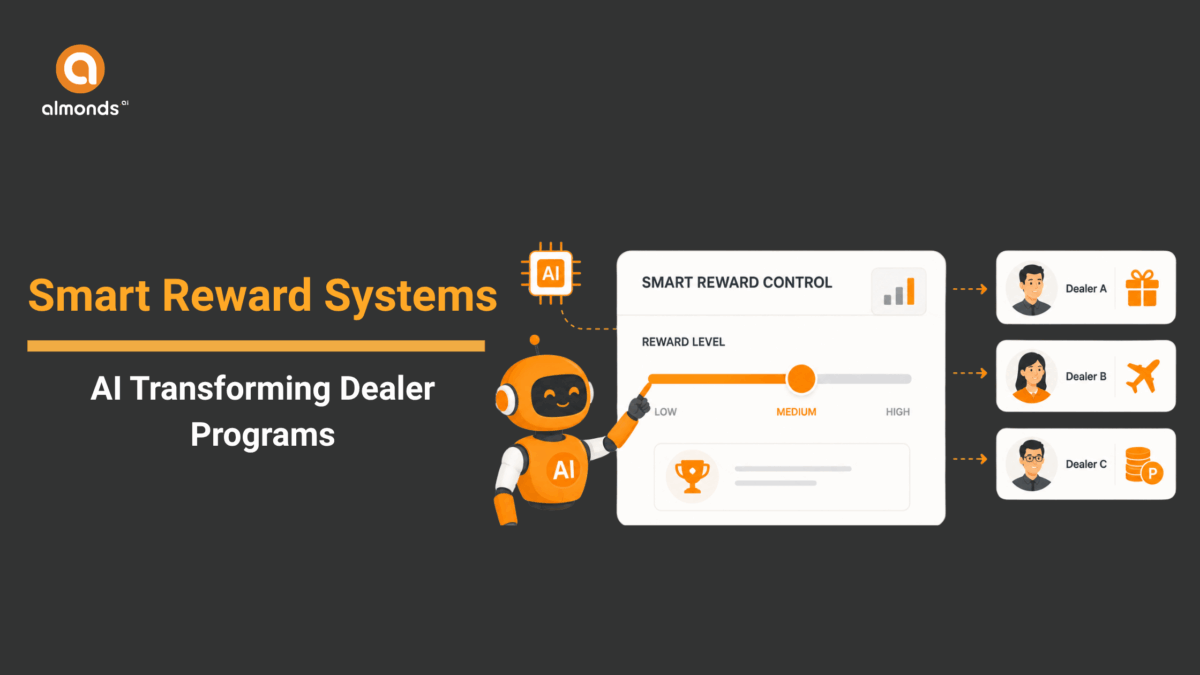
How AI-Driven Platforms Are Transforming Dealer Loyalty Programs

Dealers have become important resources of the brands to expand the market and increase product awareness and sales. Conventional incentive programs and paper-based reward systems are no longer sufficient to keep dealers active.

This is where AI-powered solutions are transforming the game. An artificial intelligence-driven dealer loyalty program is reshaping the way brands are motivating, engaging, and expanding their dealer networks.

The Limitations of Traditional Dealer Loyalty Programs

The traditional dealer loyalty programs are usually based on predetermined targets, generic rewards and delayed gratification. Such programmes are not flexible and not visible in real time, and it becomes hard to know the behaviour of dealers and the actual effect on sales of brands.

Incentives can be wasted without achieving any significant channel development. Platforms run by AI fill these gaps by adding intelligence, automation and personalisation into dealer loyalty strategies.

Customised Loyalty Experiences at Scale

Personalisation is one of the greatest benefits of AI in loyalty programs among dealers. AI uses dealer information like purchase history, product preferences, geographic trends, and performance levels to build bespoke incentive journeys.

Rather than providing incentives to all dealers, AI is allowing brands to offer incentives based on individual dealer motivations. This increases involvement, greater participation and greater sales goal correspondence.

Forecast Projections of Intelligent Rewards

Historical data is not the only thing AI-powered platforms can do. They do predictive analytics to predict the behaviour of dealers and areas of growth. As an illustration, AI may anticipate which dealers are likely to cut back on purchases or which products require a push in a particular region.

Knowing these, brands can be able to plan their campaigns proactively in such a way that the dealer loyalty program focuses on future sales and not on past performances.

Live Tracking of Performance

It is essential that dealer relationships are based on transparency and trust. Loyalty platforms based on AI have real-time dashboards that enable brands and dealers to monitor progress against targets in real time.

Dealers can view performance, points earned, and rewards availed in a single location, and brands view channel activity in regions. It is a real-time access that enhances participation and enables the brands to make timely, data-driven decisions.

Automated Programme Management

The process of running a huge network of dealers manually takes time and is likely to be error-prone. The main processes that are automated by AI are target setting, calculation of rewards, approval workflow, and fraud detection.

Such automation not only saves on operational overhead but also guarantees accuracy and fairness, which are also critical determinants of dealer trust and long engagement.

Smarter Reward Optimisation

AI can guide brands on what rewards are beneficial to the highest outcome. Through the redemption patterns and engagement data, AI platforms constantly optimize reward catalogues.

This will make sure that the dealer loyalty programs will be useful and affordable, with incentives that will actually affect the dealer behaviour rather than spending money on insignificant rewards.

Improved Dealer Communication

Smart communication is possible through AI-driven websites that deliver relevant and timely updates to dealers. With target reminders and progress notifications, AI makes sure that dealers get the appropriate message at the appropriate time.

This personalised message is consistent and available to the dealers during the entire programme lifecycle, rather than only at reward redemption levels.

Scalability Within Dealer Networks

With the expansion of business, it is complicated to manage the loyalty programs of thousands of dealers. Intelligent platforms are designed to scale easily with consistency and adjust to differences in the regions and performance.

This scalability renders AI a critical aspect of any current loyalty future of dealers, particularly brands that compete in more than one market or product line.

The Future of Dealer Loyalty Programs

It is not just that AI is enhancing dealer loyalty programs and it is defining them. Smart segmentation and predictive analytics are only the beginning of AI-based platforms transforming loyalty initiatives into strategic growth engines.

Loyalty programs powered by AI help brands to have a better relationship with dealers, better channel performance, and higher ROI on incentive spending.

Final Thoughts

An informed, smart dealer loyalty program is no longer a luxury but a requirement in the current competitive B2B field. AI-driven platforms enable brands to go beyond generic incentives and develop meaningful and performance-based interactions with dealers.

Are you prepared to change your dealer loyalty approach using AI? Team up with Almond Ai to create smarter, scalable and results-driven loyalty programs for your dealers.

806 Post views
Categories
Blogs

Loyalty Rewards vs Discounts: What Works Better for Retention?

Retaining channel partners (retailers, distributors and resellers) is equally important in competitive B2B markets, as is their acquisition. Price discounts keep the brand competitive, yet in the long run, they can be damaging to margins and do not provide long-term channel partner loyalty.

Loyalty rewards are brought up at this point. In the case of B2B ventures and more so business ventures that use channel partners, the real issue is: which is a better retention strategy; loyalty rewards or discounts?

This blog discusses the two methods and why loyalty rewards are proved to be the smarter and more sustainable way to retain B2B.

Understanding Discounts in B2B Relationships

Discounts are straightforward. Offer a lower price, and partners respond with higher short-term sales. In B2B, discounts are often used to clear inventory, push seasonal products, or win deals against competitors.

However, discounts have clear limitations:

  • Short-term impact: Once the discount ends, buying behaviour often drops.
  • Price-focused relationships: Partners may stay only as long as prices are low.
  • Margin pressure: Frequent discounts reduce profitability for both brands and partners.
  • Easy to copy: Competitors can match or beat discounts quickly.

While discounts can boost volumes temporarily, they rarely create emotional or strategic loyalty. Channel partners may switch brands as soon as a better price appears.

What Are Loyalty Rewards in B2B?

Unlike consumer loyalty programs, B2B loyalty rewards are designed to strengthen long-term partnerships. These programs reward partners not just for purchases but also for behaviours that matter to the brand, such as:

  • Consistent ordering
  • Achieving sales targets
  • Promoting specific product lines
  • Participating in training or certifications
  • Long-term engagement with the brand

Rewards can include points, tier-based benefits, travel incentives, digital vouchers, exclusive access, or business support tools. The key difference is that loyalty rewards focus on relationship value, not just price.

Loyalty Rewards vs Discounts: A Direct Comparison

  1. Retention Value

A true purchase will only be made repeatedly when the price advantage is presented. On the other hand, loyalty rewards cultivate continued interaction. Partners are also sticking around because of the long-term benefits for the partners rather than the short-term savings.

  1. Partner Motivation

Discounts will be used to reward all, irrespective of hard work or loyalty. Loyalty rewards could be tailored to encourage certain behaviour like upselling or expanding the markets; thus, they are much more effective in the B2B settings.

  1. Brand Differentiation

Discounts put your brand amongst a host of brands that offer cheap products. Loyalty rewards generate a special environment that is not easily duplicable by competitors. This will make your brand more remembered and difficult to substitute.

  1. Profitability

Continued discounts undermine margins. Properly designed loyalty program enable the brands to manage expenses and yet achieve high perceived value by partners.

Why Loyalty Rewards Work Better for Channel Partners?

B2B relationships are built on trust, consistency, and mutual growth. Channel partners invest time and resources into brands they believe in. Loyalty rewards support this mindset by:

  • Recognising partner efforts beyond just sales volume
  • Encouraging long-term collaboration instead of one-time transactions
  • Providing non-cash incentives that feel more meaningful than discounts
  • Creating emotional loyalty, not just financial dependency

For distributors and retailers, being part of a structured loyalty programme makes them feel valued and invested in the brand’s success.

The Best Strategy: Smart Loyalty Rewards program

The best B2B brands offer discounts that are sparse with strong loyalty rewards programs. In so doing, they are maximising short-term sales, and they are gaining the loyalty of partners in the long run.

With the modern platforms, it is now simpler to develop, monitor, and expand the channel partner loyalty rewards programme. The appropriate data and automation allow brands to be personal with rewards, track engagement, and keep improving retention tactics.

Why is Almond AI a Great Approach to B2B Partners?

At Almond AI, our loyalty program is designed specifically for channel partners, including retailers and distributors. Our solutions assist brands to go beyond price wars and create meaningful, long-term relationships with smart loyalty rewards.

Using Almond AI, businesses are able to:

  • Design tailored reward program on loyalty.
  • Reward desirable behaviours of partners.
  • Real-time understanding of partner performance.
  • Enhance retention and still generate profits.

Final Thoughts

Discounts can gain short-term sales; loyalty rewards can gain long-term alliances when it comes to retention. In the case of B2B brands with channel partners, loyalty rewards provide more engagement, relationships, and long-term growth.

When you need to keep partners who are committed to the success of your brand, it is time to leave the discounts and invest in loyalty rewards. Willing to develop a more intelligent B2B loyalty program? Choose Almond AI and transform your channel partners into long-term brand sponsors.

862 Post views
Categories
Blogs

Turning First-Time Buyers into Repeat Customers with a Rewards Program

The B2B competitive environment does not stop at the purchase of a new buyer. The real issue is to convert the first-time buyers, including retailers, distributors and channel partners, into long-term and loyal business partners.

B2B buyers, unlike B2C customers, are driven by profitability, reliability, and long-term value as the basis of the decision-making process. This is where an effective rewards programme will be a significant growth instrument.

In the case of businesses that deal with channel partners, discounts do not suffice in creating loyalty. It is constructed using recognition, incentives, and continuous interaction. An effective B2B rewards programme will help to turn one-time sales into a series of partnerships.

How a Rewards Programme Drives Repeat Purchases in B2B?

A B2B rewards programme does not deal with immediate gratification. It has to do with stimulating repeat purchase – repeat quantity purchase and brand advocacy. Loyalty is a business choice and not an emotional one when the channel partners are aware that their activity results in real benefits.

This is how a reward system can be used to convert first-time customers into regular customers:

  1. Rewarding Systematic Purchasing

Rewarding repeat purchases means that you make your partners reorder your brand instead of changing the supplier. Rewards in the form of points, boosts of tiers or incentives on milestones keep them active even after the initial sale.

  1. Increasing Order Value

The rewards programme should be well structured to encourage partners to order at a higher level to introduce superior rewards. This has a direct effect on revenue and enhances the relationship of the partner.

  1. Enhancing Brand Preference

It becomes the brand of choice when your brand identifies and rewards partner efforts on a consistent basis. The loyalty towards price-based decisions would change to value-based alliances over time.

  1. Establishing Long-Term Engagement

Constant rewards, campaigns, and rewards based on performance can ensure that your partners are interested not only in promotions but also on an annual basis.

Designing a Rewards Programme for Channel Partners

In the case of the B2B brands (mostly those that deal with distributors and retailers), a rewards programme should be functional, expandable and manageable.

The components of an effective B2B rewards programme are:

Clear Earning Structure

Channel partners must be well aware of the method of rewarding them, whether by sales volume, repeat purchases, product focus or prompt payments.

Relevant Rewards

B2B rewards are to be based on the professional needs, unlike B2C. These can be in the form of digital vouchers, business rewards, travel or merchandise, or experience placement, which drive performance.

Tier-Based Recognition

Tiered rewards programmes promote long-term commitment. Promotion of partners as they rise in levels gives them better incentive, special treatment and increased recognition.

Real-Time Tracking

Partners will be more motivated when they are able to see their progress. The rewards programme will be more interactive and reliable because of transparent dashboards and real-time updates.

Technology in B2B Rewards Programmes

A B2B rewards programme is often complex to manage manually, particularly when it has to deal with multiple channel partners in different regions. Here, AI-driven services come in very handy.

Technology can be used to automate reward tracking, customize rewards, and offer actionable insights. Data-driven intelligence enables companies to learn about partner behaviour and make reward strategies more efficient to boost retention.

Why a Rewards Programme Is No Longer Optional in B2B?

In the current market situation, channel partners will demand more than competitive prices. They want to be appreciated and rewarded and have a motivation to remain loyal. A loyalty programme that is implemented properly will help fill the gap between new buyers and loyal customers.

Brands that spend on B2B loyalty experience increased rates of repeat purchases, greater partner involvement and better market representation. It is not only retention but long-term growth.

How Does Almond AI Help Convert First-Time Buyers into Loyal Partners?

At Almond Ai, the focus is on B2B loyalty programmes built specifically for channel partners—retailers, distributors, and sales networks. Unlike generic loyalty platforms, Almond Ai understands the complexity of B2B ecosystems.

Almond AI enables businesses to:

  • Launch customised B2B rewards programmes with ease
  • Track partner performance in real time
  • Offer meaningful, high-impact rewards
  • Automate reward fulfilment and communication
  • Strengthen long-term channel relationships

By using Almond Ai, businesses can turn their rewards programme into a strategic growth engine rather than just a marketing expense.

Conclusion

The good product is not enough to get the first-time buyers to become repeat customers. It needs an effective strategy when engaging partners. A well-planned rewards programme assists companies in motivating, retaining and developing channel partners in the long run.

Under Almond Ai, companies can establish robust B2B reward programmes that will lead to re-buys, stronger loyalty, and enduring relationships. Be ready to convert first-time buyers to long-term partners? Create an AI-enhanced, smarter B2B rewards programme using Almond AI and unlock channel growth sustainability.

828 Post views
Categories
Blogs

Why Most Channel Loyalty Programs Fail?

When channel loyalty programs underperform, most brands reach the same conclusion. The rewards aren’t exciting enough. So budgets are increased. Catalogs are expanded. New quarterly schemes are rolled out. Sometimes, even premium gifts are added, assuming that higher value will automatically translate into higher engagement. Yet, participation continues to decline. Retailers disengage. Field teams struggle to explain programs. And leadership starts questioning whether loyalty even works. 

The reality is far more uncomfortable. 

It's not always about rewards to fail the loyalty programs

Channel Loyalty Through Daily Experience

For brands, loyalty often exists as a scheme document, a dashboard, or a quarterly presentation. For retailers, loyalty is lived on the shop floor, every single day. In India’s channel ecosystem, especially retailers & distributors: 

  • Manage hundreds of SKUs
  • Make stocking decisions daily
  • Operate on tight cash cycles
  • Rely on speed, memory, and trust 

A loyalty program that doesn’t fit into this reality will fail quietly, without complaints, without escalation, and without warning. That silent failure is what makes channel loyalty so deceptive. 


Mistake 1: Designing Loyalty for Internal Convenience, Not Channel Reality 

Most loyalty programs are designed inside boardrooms, not behind the counter. They prioritize: 

  • Finance-friendly slabs
  • Audit-driven validations
  • Internal approval workflows
  • Campaign calendars

But none of these matters to a retailer, who is trying to run a business. 

If earning points requires remembering multiple conditions, tracking SKU-level multipliers, or interpreting fine print, the program instantly becomes cognitive load. And in a kirana environment, cognitive load is the fastest path to disengagement.  

Retailers don’t consciously reject such programs. They simply stop paying attention. 


Mistake 2: Delayed Rewards in a Fast-Moving Cash Economy 

In the Indian general trade, cash flow is not a preference; it is survival. Many retailers rotate stock every 3–7 days. They rely on predictable inflows to maintain smooth operations. In this context, loyalty programs that promise rewards weeks or months later feel uncertain and risky. 

Delayed payouts don’t just reduce motivation. They erode trust. Market studies across show that programs offering instant rewards consistently drive 35–50% higher repeat participation compared to delayed settlement models. 

Speed doesn’t just improve engagement. It signals reliability. 


Mistake 3: Earning Rules That Feel Like a Trap, Not an Incentive 

One of the biggest reasons retailers drop off loyalty programs is not low reward value; it’s confusion. Common issues include: 

  • Frequent rule changes without communication
  • Region-specific exclusions
  • SKU-level multipliers that are hard to track
  • Slabs that reset mid-cycle 

From a retailer’s perspective, this creates suspicion. The belief slowly forms that the program is designed to reduce payouts, not reward effort. Interestingly, research shows that over 50% of Indian retailers prefer simpler, transparent earning structures even if the reward amount is lower. 

Loyalty chain: How to build loyalty

 Mistake 4: Manual Claims That Break Trust Before They Break Systems 

Many channel loyalty programs still rely on manual processes, WhatsApp uploads, field executive validation, PDF invoices, and Excel sheets. This introduces friction at multiple levels. 

Human error becomes unavoidable. Invoices get misread or misclassified. Claims are rejected for reasons retailers don’t fully understand. Industry audits indicate that nearly 20–25% of rejected claims are due to processing errors, not fraud. 

For retailers, however, every rejection feels intentional. And once that perception sets in, the emotional relationship with the brand weakens rapidly. Automation, in this context, is not about efficiency. It is about restoring fairness and trust. 


Mistake 5: Treating All Channel Partners as One Audience 

A distributor, a high-volume retailer, and a long-tail kirana operate under very different constraints. 

Yet most loyalty programs offer: 

  • The same rewards
  • The same slabs
  • The same communication
  • The same journey 

Retailer preference studies across India reveal a clear shift: 

  • ~60% prefer instant cash or wallet credits
  • ~30% value business-oriented rewards like inventory credit or store upgrades
  • Less than 15% prioritize lifestyle or personal gifts 

Loyalty fails when rewards don’t support the retailer’s business reality. 


The Hidden Cost of Loyalty Failure 

When loyalty programs fail, brands rarely see an immediate drop in numbers. What they lose is more subtle: 

  • Recommendation priority
  • Shelf visibility
  • Push during competitive moments
  • Mindshare during new launches 

Retailers don’t exit loudly. They redirect effort silently. And that silent shift costs brands far more than any reward budget. 


What Actually Works in High-Performing Channel Loyalty Programs 

Winning programs are not louder or more complex. They are simpler, faster, and more respectful of how channel partners operate. They focus on: 

  • Real-time visibility into earnings
  • Predictable and timely rewards
  • Clear, stable earning logic
  • Automated claim validation
  • Recognition layered alongside rewards
  • Personalization driven by behavior, not assumptions 

These programs feel less like schemes and more like partnerships. 


Loyalty Is Infrastructure, Not a Scheme 

The most important mindset shift brands must make is this: 

Channel loyalty is not a quarterly campaign. It is not a catalog refresh. And it is not a cost center.  It is infrastructure. When built correctly, loyalty becomes the invisible engine that drives trust, consistency, and long-term advocacy across the channel. 


Final Thought 

If your channel loyalty program isn’t delivering results, don’t start by questioning the rewards. Start by asking: 

  • Is the experience simple?
  • Is it fast?
  • Is it predictable?
  • Is it fair? 

Because loyalty doesn’t fail at redemption. It fails much earlier, at design. 

923 Post views